



 +94 (0) 31 228 1114
 info@cocopeatcoirmulch.com
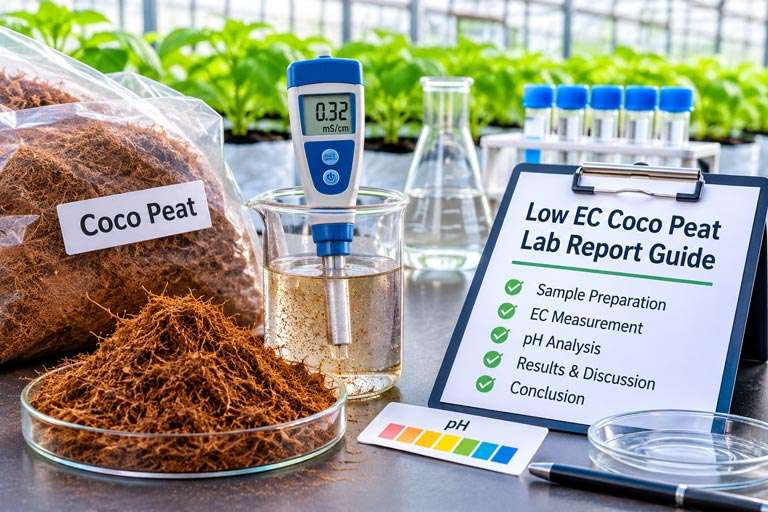

Low EC Coco Peat
Low EC Coco Peat: 7 Lab Numbers to Check Before You Place a Bulk Order
Low EC coco peat is the phrase every grower types into Google before a bulk order, and the phrase almost every supplier uses without explaining it. So what does it really mean? And how can you tell whether the pallet that lands at your gate matches the promise on the quote? This guide walks through the seven lab numbers that tomato, pepper, cucumber, melon and berry growers check before they say yes. None of it needs a chemistry degree. It needs a lab report and the right questions.
A quick confession first: I’ve seen more than one farm skip this step, then spend a month chasing leaf-tip burn that traced back to the media. Let’s make sure that’s not you.
What does “low EC” actually mean on a spec sheet?
EC stands for electrical conductivity. In plain words, it tells you how many dissolved salts are sitting in the medium. Pure water reads close to zero. Salty water reads high. You’ll see it written in dS/m or mS/cm; the number is the same either way.
Many commercial specifications call coir low EC when a water extract reads below about 0.5 mS/cm, and some growers of hardy crops accept readings up to about 1.0. Treat those as common ranges, not laws. Your crop, your water and your feed recipe all shift the line.
Why should you care? Because young roots are touchy. A seedling planted into salty fibre has to pull water against that salt, and it loses. Growth slows, leaf edges brown, and you start adjusting feed to fix a problem the bag created.
Why is coco peat salty in the first place?
Coconut husk isn’t a lab-made material. It grows on a palm, often near the coast, and it carries what the tree took up. According to Wikipedia’s entry on coir, coir pith is naturally high in sodium and potassium, and one kilogram of dry coco peat can expand to about 15 litres once it’s wet. That swelling is the good part. The salt is the part you need to watch.
Processing matters too. Husks that soak in brackish water before they’re crushed can pick up extra salt. That’s why two blocks that look identical can read very differently on a meter. Looks tell you almost nothing, and a lab tells you almost everything.
Washed vs unwashed coco peat: what’s really different?
Washed coco peat has been rinsed with fresh water, often more than once, then drained and dried or aged before it’s pressed into blocks. Unwashed pith skips that rinse, so its EC can sit well above 1.0 and sometimes much higher. It’s cheaper to produce, which is why it shows up in the cheapest quotes.
Here’s the twist, though. Washed doesn’t automatically mean good. A badly rinsed batch can still be salty, and a well-rinsed batch can still have the wrong particle mix. So don’t stop at the word “washed”. Ask how many rinses, what water was used, and ask to see the numbers.
Low EC coco peat: the 7 lab numbers that matter
Here’s the checklist I give clients. If a supplier can’t send these seven values for the actual batch, that tells you something already.
Number 1: EC, and the method behind it
Ask for the EC value, but also ask how it was measured. A 1:1.5 extract and a 1:5 extract give different numbers from the same fibre. A quote that says “EC 0.4” means little until you know which method produced it. Match the method to the one your own lab uses so you can compare like with like.
Number 2: pH
Most coir for fruiting crops lands somewhere around pH 5.5 to 6.8 in the extract. Coir can drift upward over months, so a starting pH at the low-to-middle part of that range gives you room. A starting pH near the top leaves you less to work with.
Number 3: Sodium and chloride
This pair does the real damage. EC is a total, and it can look fine while sodium and chloride hide inside it. Sodium and chloride in coir matter most for salt-shy crops like strawberry and pepper, and for any farm that recycles its drain water. Ask for both values in mg/L or mmol/L, and keep them on file.
Number 4: Potassium
Coir carries a lot of potassium, and it gives it up slowly. A high starting value isn’t a disaster, but it does mean your first weeks of feed should be lighter on potassium. Know it before you mix your first tank, not after.
Number 5: Moisture and expansion volume
Coco peat moisture content tells you what you’re paying to ship. Compressed blocks commonly sit at roughly 15 to 20 percent moisture; much higher and you’re buying water by the tonne. Ask for the expansion volume too, in litres per block or per kilogram. A Coco peat Bale that expands to less than promised can leave your bags half empty after a hard day of filling.
Number 6: Particle mix
Coir isn’t one thing. It’s a blend of fine pith, short fibre and sometimes small chips. Too much fine pith and the bag holds water like a sponge with no air. Too much coarse fibre and it dries too fast. Ask for the particle size distribution, or the pith, fibre and chip ratio, and compare it with what your crop likes.
Number 7: Water holding and air space
Particle size and water holding capacity go together. Ask for water-holding capacity and air-filled porosity after the medium is wet and drained. These two numbers show how the bag will behave on a hot afternoon, when the roots need water and air at the same time. Think of it as the difference between a damp sponge and a soaked one.
Which crops care most about a low starting EC?
Not every crop reacts the same way. Strawberries and peppers are the sensitive ones; a salty start shows up quickly as stunted roots and burnt leaf margins. Cucumbers and melons sit in the middle. Tomatoes tolerate a bit more, which is why some tomato growers accept a higher starting EC and just flush a little longer.
Your water source changes the picture, too. If your irrigation water already carries sodium, you have less room to spare, and a salty bag pushes you over the edge sooner. Growers in dry regions like parts of Mexico and the Gulf know this well, and they tend to be the strictest buyers.
Three mistakes people make when reading the numbers
The first mistake is comparing numbers from different methods. A 1:5 result and a 1:1.5 result aren’t twins, and mixing them makes one supplier look better than another for no real reason. The second is trusting a single sample from a large order. Coir batches vary, so ask for numbers from more than one block, or from each lot in the container.
The third is the sneaky one: treating the lab sheet as a finish line. A report is a snapshot of one day. Storage matters too. Blocks kept damp or stacked in humid sheds can change over time, so keep them dry and off the floor until you need them.
How to ask your supplier for the report
Keep it simple. Ask for a coir lab test report from an independent lab, for the batch you’re buying, dated within the last few months. Ask which extract method was used. Ask for a small trial sample drawn from the same lot, and keep a retained sample from your delivered container so you can test it if a problem shows up.
Watch for red flags. A report with no batch number is one. A report copied from last year is another. And a supplier who answers “our coir is always low EC” without a number is telling you a story instead of a fact. A good supplier will send the file within a day, usually with a smile.
A quick check you can run at the farm
You don’t need to wait for a lab. Hydrate a sample block with clean water, let it stand, and collect the drain. Read the EC and pH with a calibrated meter. Compare the result with the report. If the two disagree by a wide margin, call the supplier before you fill a thousand bags.
Calibrate the meter first, though. A drifting meter will blame the coir for something it didn’t do, and that’s an awkward phone call.
What growers tell us about washed coir
I used this seven-number list as a one-page buyer’s sheet for a client who was importing coir for the first time, and it cut their back-and-forth with suppliers down to a single email. Having the numbers in one place changed the conversation.
Our customers are really happy with the steady EC readings from batch to batch, and a tomato grower in Canada told us: “We stopped worrying about the first two weeks after planting. The drain numbers matched the report, so the feed plan just worked.” That’s the goal. No drama in week one.
So, what’s your next move?
Write the seven numbers on a card. Send it with your next enquiry. Compare the replies side by side, and don’t be shy about asking for the batch report before you commit.
When the numbers look right, test a small run in your own house. Fill a short row of Coco Peat Grow Bags, plant it, and watch the drain for two weeks. Then scale up. Honestly, that small test costs very little and saves a lot of stress.
Frequently Asked Questions
What EC should coco peat have for greenhouse crops?
Many commercial specifications treat a water extract below about 0.5 mS/cm as low EC, and some growers of hardy crops accept up to about 1.0. Salt-shy crops like strawberry and pepper do best at the lower end. Always check which extract method the number came from.
What is the difference between washed and unwashed coco peat?
Washed coco peat is rinsed with fresh water to remove salts before it is dried and pressed. Unwashed pith skips the rinse, so its EC is often much higher. Ask how many rinses were used and ask for a lab report for the batch.
Why do sodium and chloride matter if the EC looks fine?
EC is a total of all dissolved salts. Sodium and chloride can hide inside it, and they harm roots and build up in recycled drain water. Asking for both values separately gives you a clearer picture.
What should a coir lab test report include?
At a minimum: EC and the extract method, pH, sodium, chloride and potassium, moisture content, expansion volume, particle size distribution, and water-holding capacity or air-filled porosity. It should name the batch and the test date.
Can I fix a salty batch of coir on my own farm?
Often, yes. Flush the bags with clean water until the drain EC settles close to your irrigation water, then retest. It costs time and water, though, which is why checking the numbers before you buy is the better route.
