



 +94 (0) 31 228 1114
 info@cocopeatcoirmulch.com
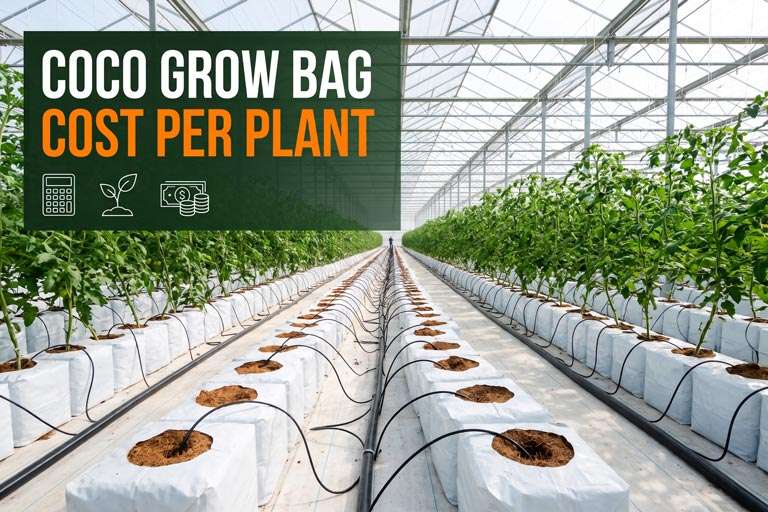

Coco Grow Bag Cost Per Plant
Coco Grow Bag Cost Per Plant: 6 Numbers Every Greenhouse Owner Should Run
Coco grow bag cost per plant is the number that decides whether your next crop makes money, yet most owners only look at the price on the quote. A bag that costs a few cents less can cost you dollars in lost fruit, extra freight or a second order that arrives late. So let’s slow down and do the sums properly. This guide gives tomato, pepper, cucumber, melon and berry growers six numbers to run before they place an order, with a worked example you can copy into a spreadsheet.
Fair warning: every figure in the example is illustrative. Swap in your own quote, your own crop and your own prices.
Why the price on the quote isn’t the real cost
A quote tells you what one bag costs at one point on the map. It doesn’t tell you what the bag costs once it reaches your greenhouse, how many plants it feeds, or what it does for yield. Think of it like buying a car by looking only at the sticker. You’d be surprised what hides behind it.
The honest way to compare bags is to turn every offer into a single figure: cost per plant, and then cost per kilogram of fruit. Once you have those two, a cheap-looking bag and an expensive-looking bag finally sit on the same table. And sometimes the expensive one wins.
Coco grow bag cost per plant: the six numbers, one by one
Take them in order. Each one feeds the next, and you only need a calculator and your supplier’s reply.
Number 1: The landed price, not the factory price
Start with what the bag costs delivered to your door. That means the factory or FOB price plus sea freight, insurance, import duty, port charges and trucking. Two quotes with the same ex-works price can land very differently once freight is added. Ask each supplier for a delivered figure to your nearest port, and add your own local costs on top.
Add a small allowance for breakage and spares too. A few percent is normal, and it’s easier to plan for it than to explain it later.
Number 2: Plants per bag
Next, divide that landed price by the number of plants each bag carries. High-wire tomato slabs often carry two or three plants, cucumbers commonly two, and peppers two or three, while strawberries fit more plants into a bag. Your seed company’s crop guide gives the right figure for your variety. If you grow tomato, grow bags for tomato are the usual starting point, and it’s worth checking the bag length against your gutter spacing before you order.
Here’s the formula. Cost per plant equals landed bag price divided by plants per bag. That’s it. Simple enough to do on the back of a seed packet.
Number 3: Bags per hectare
Now scale up. Grow bags per hectare depends on your plant density and how many plants share a bag. Take your plants per square metre, multiply by your net growing area, and divide by plants per bag. Use net growing area, not the whole footprint, because aisles and service paths don’t hold bags.
Then add a small allowance of spare bags for replacements. It’s the number your purchase order should carry, and it’s the one people most often get wrong by working from the wrong area.
Number 4: Bag volume vs yield
This is where owners lose or win real money. A larger bag costs more, but it can hold more water, stay steadier in hot weather and support a stronger root system. The question is whether the extra yield pays for the extra cost.
Work it backwards. Take the extra cost per plant and divide by your selling price per kilogram. The answer is the extra fruit each plant must give you to break even. If that figure is small, a bigger bag is an easy call. If it’s large, stay with the smaller bag. A Coco Peat Grow Bags range with a few size choices lets you test this on one row before you commit the whole house.
Number 5: How many crop cycles you’ll get
If a bag serves two clean crop cycles, its cost per cycle drops by half. But second-crop use has its own costs: flushing, steaming or disinfecting, lab tests and some labour. And it only makes sense when the first crop was healthy and the bag still drains evenly.
So don’t assume two cycles by default. Run both versions on paper, one cycle and two cycles, and see which one holds up. Then use the lower-risk figure for your budget, and treat a second crop as a bonus if it works out.
Number 6: Freight, bags per container and lead time
Coir comes from the major producing countries, and the International Coconut Community (ICC) lists coir pith and fibre among its husk-based products. That means your bags usually travel a long way by sea. Ask each supplier how many bags fit in a 40 ft container for your exact size, whether the bags ship dry and compressed, what the minimum order is, and how long production takes.
Bags per container matters more than it sounds. If one supplier fits twenty percent more bags in a box, your freight per bag drops by a similar share. Lead time matters just as much. A late container can cost you a planting window, and no discount makes up for that.
A worked example you can copy
Let’s use a tomato house with 1,000 square metres of net growing area. Again, these numbers are only for illustration. Say you plant 2.8 stems per square metre, which gives 2,800 plants. With three plants per bag, you need about 933 bags, so round up to 960 to cover spares.
Suppose the landed price is 2.50 dollars per bag. That’s 2,400 dollars for the house, or about 0.86 dollars per plant per crop. If each plant gives 20 kilograms of fruit, the bag cost works out at roughly 4 cents per kilogram. Suddenly the bag looks small next to the crop it carries.
Now test a larger bag at 3.00 dollars. The extra cost is 0.50 dollars per bag, or about 0.17 dollars per plant. If tomatoes sell at 1.50 dollars per kilogram, each plant only needs to give about 110 grams of extra fruit to break even. Does that sound achievable? For many houses, yes. For some, no. Which is exactly why you test one row first.
Payback period works the same way. Add up the extra cost of the bigger bag across the house, divide by the extra income it creates each week of harvest, and you’ll see how many weeks it needs to pay for itself. A payback inside one crop is a comfortable result.
How the numbers shift from crop to crop
The method stays the same, but the inputs change. Cucumbers and peppers usually run at lower plant densities than tomato, so each bag carries fewer plants per square metre of floor. Strawberries pack many small plants into each bag, which pushes the cost per plant down but raises the importance of bag length and gutter fit. Melons are heavy feeders with big root systems, so volume matters more than anything else.
That’s why a single “best bag” doesn’t exist. The right bag is the one that gives your crop, in your climate, the lowest cost per kilogram of fruit. Run the six numbers for each crop separately, and keep the spreadsheet for next season.
How to read a quote line by line
When a quote lands in your inbox, check five things before you look at the total. Is the price FOB, CIF or delivered? Which bag size and fibre grade does it cover? How many bags fit in a container? What’s the minimum order, and what’s the lead time from deposit to loading? And what happens if a batch arrives out of spec?
A clear supplier answers all five without being chased. If a reply skips two or three of them, treat the missing answers as costs you haven’t seen yet.
Mistakes that skew the sum
A few errors turn up again and again. Owners compare ex-works prices with delivered prices. They count the whole greenhouse footprint instead of the net growing area. They forget spares. They assume a second crop without budgeting the clean-up. Or they pick the smallest bag because it won the price comparison, then wonder why the plants dry out on hot afternoons.
None of these is hard to fix. They just need someone to put the numbers on one page before the order goes out.
What growers tell us about getting the sums right
I used this six-number method as a planning sheet for a client who was expanding a tomato house, and it turned a vague “which bag is cheaper?” chat into a clear yes or no in one meeting. The spreadsheet took twenty minutes to build.
Our customers are really happy when we send them landed prices and bags-per-container figures up front, and a greenhouse owner in Canada said it like this: “We finally had two quotes we could compare line by line. We ordered the bigger bag for one house and kept the standard bag in the other, and the numbers settled the argument for us.” That’s the kind of clarity a quote should give you.
Where do you go from here?
Open a spreadsheet and list the six numbers for each supplier. Ask for the landed price, the plants-per-bag guide, the container loading figure and the lead time. Then run your own break-even for the bigger bag.
It’s not glamorous work. But it’s the sort of homework that protects your margin for the whole season, and a calm, well-planned order is a lovely thing to have in your inbox.
Frequently Asked Questions
How do I calculate grow bag cost per plant?
Divide the landed price of one bag by the number of plants it carries. Landed price means the delivered cost, including freight, duty, port charges and trucking, not just the factory price.
How many grow bags do I need per hectare?
Multiply your plants per square metre by your net growing area, divide by plants per bag, then add a small allowance for spares. Use net growing area, not the whole greenhouse footprint.
Is a bigger grow bag worth the extra cost?
It can be. Divide the extra cost per plant by your selling price per kilogram to find how much extra fruit each plant must give to break even. If that figure is small, the bigger bag usually pays for itself. Test it on one row first.
How many plants can one coco grow bag support?
It depends on the crop and bag size. Tomato, cucumber and pepper bags commonly carry two or three plants, while strawberry bags carry more. Your seed supplier’s crop guide gives the right number for your variety.
What should I ask a supplier before ordering grow bags in bulk?
Ask for the delivered price to your port, the number of bags per 40 ft container for your size, whether bags ship dry and compressed, the minimum order, and the production lead time.
