



 +94 (0) 31 228 1114
  info@cocopeatcoirmulch.com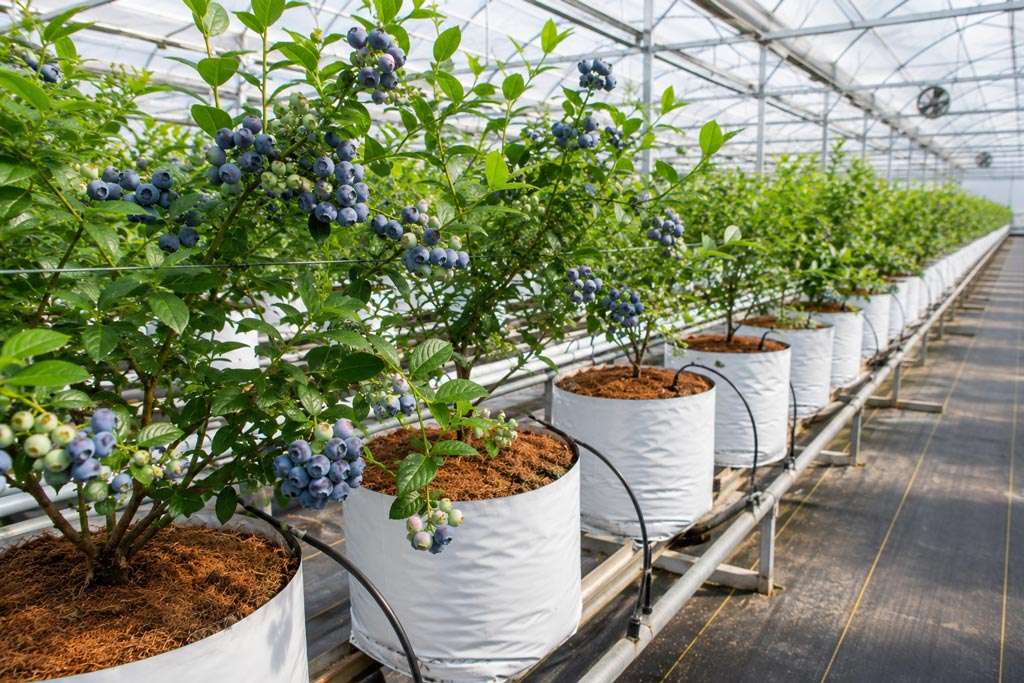

Growing Blueberries in Coco Coir: 9 Steps to Heavy Harvests
Growing Blueberries in Coco Coir: 9 Steps to Heavy Harvests in Containers
Ten years ago, if you told a blueberry farmer in Michigan or Chile that the fastest-growing berry operations would soon be planting into pots of coconut husk instead of acid-amended soil, you would have gotten a polite laugh. Nobody is laughing now. Growing blueberries in coco coir has become the standard model for new commercial plantings from Peru to Morocco to South Korea, and for a simple reason: it works better, faster, and in places where blueberries were never supposed to grow at all.
Soil-grown blueberries demand something most farmland does not have, a naturally acidic, free-draining, organic-rich profile. Amending soil to fake those conditions takes years and never fully sticks. Containers filled with coir skip the whole argument. You build the perfect root zone from day one, drop it anywhere with sun and water, and start harvesting in year two instead of year four.
Here is the nine-step playbook that commercial growers are using, plus the mistakes that catch newcomers.
Step 1: Understand Why Blueberries and Coir Get Along So Well
Blueberry roots are shallow, fine, and fibrous, almost hair-like, with no root hairs of their own. They suffocate in heavy soil and drown in stagnant water. What they want is constant moisture held in an airy, open structure, which happens to be a near-perfect description of coco coir.
Coir also sits naturally in a mildly acidic pH range of roughly 5.5 to 6.5, right at the doorstep of the 4.5 to 5.5 zone blueberries prefer. Nudging it down with acidified fertigation is trivial compared to fighting alkaline field soil season after season. As the coir reference on Wikipedia points out, coir pith can hold many times its weight in water while still keeping air in the profile, which is exactly the moist-but-breathing balance those fine blueberry roots evolved for in forest-edge soils.
There is a second, less romantic reason the pairing works: disease pressure. Field blueberries battle phytophthora and other soilborne root rots for their entire lives, and once those pathogens are in the ground, they stay. A fresh container of coir starts clean. Combine that with drip fertigation that never splashes the crown, and root disease drops from a chronic threat to an occasional nuisance. Fewer fungicide passes, fewer mystery declines, fewer replant headaches. For an operation planning a decade ahead, that alone can justify the switch.
Step 2: Pick the Right Container and Volume
Commercial operations run two main formats. The first is rigid plastic pots of 25 to 60 liters filled with loose coir substrate. The second, increasingly popular in high-density plantings, is purpose-made coir grow bags where the container and the substrate arrive as one compressed unit.
Volume matters more than shape. Young plants go into 10 to 15 liters; mature production bushes want 40 liters or more, because canopy size tracks root volume almost linearly. Many growers start plants in smaller open top planter bags for the first year, then shift up. Skimping on final volume is the single most common way new blueberry projects cap their own yields, so if the budget forces a choice, spend it on liters.
Step 3: Get the Substrate Blend Right
Pure fine coir pith holds too much water for a five-year blueberry crop. It slumps over time and the bottom third of the pot goes soggy. The fix is structure. The blends that dominate commercial plantings look like this:
- 50 to 70 percent coco chips for long-term air space and drainage
- 30 to 50 percent coir pith for water holding and capillary spread
- Optional 10 percent coir fiber to knit the profile together
Chip-heavy blends keep their structure for the full life of the planting, five to eight years, without collapsing. That longevity is the quiet economic engine of the whole system, because replacing substrate mid-crop is expensive and disruptive. Ask your supplier for the chip-to-pith ratio in writing, and ask for washed, low-EC material with batch test data. Blueberries are salt-sensitive, and starting EC above 0.5 mS/cm in the substrate is asking for trouble.
Step 4: Nail the pH and Water Quality Before You Plant
This is where blueberry projects live or die. Target a root-zone pH of 4.5 to 5.5, maintained through acidified nutrient solution, usually with sulfuric, nitric, or citric acid injection depending on your water. Test your source water first. High-bicarbonate water fights your acid injection every single day, and reverse osmosis may be worth the investment if alkalinity runs above 150 ppm.
Feed with an ammonium-leaning nitrogen program, since blueberries prefer ammonium over nitrate and it helps hold pH down naturally. Keep feed EC modest, typically 0.8 to 1.2 mS/cm for young plants and up to 1.5 during heavy fruiting. Little and often beats big and rare.
Step 5: Set Up Irrigation Like a Berry Grower, Not a Vegetable Grower
Coir spreads water sideways beautifully, but blueberry pots still need two to four drippers per container to wet the full profile evenly, because those fibrous roots colonize wherever the water goes and nowhere else. Aim for many short irrigation pulses through the day, keeping substrate moisture between 60 and 80 percent of container capacity. Push 10 to 20 percent drain on sunny days to keep salts moving out of the pot.
Sounds fussy? A basic fertigation controller handles all of it. The real discipline is checking drain EC and pH twice a week and actually acting on the numbers.
Two mistakes come up again and again with new container growers. The first is running one big irrigation event per day, soil habits die hard, which swings the pot from soaked to dry and stresses those shallow roots at both ends. The second is ignoring drain entirely because water is expensive. Some drain is not waste; it is your salt management and your best diagnostic tool rolled into one. Catch it, measure it, and if your setup allows, recirculate it after treatment.
Step 6: Choose Varieties Bred for Pots
Modern breeding changed this game. Low-chill and no-chill varieties from programs in Florida, Australia, and Spain were practically made for container culture: compact, fast to fruit, and happy in mild winters. That is how Peru went from nowhere to the largest blueberry exporter on earth in under a decade, almost entirely on coir-based container systems. Talk to your nursery about licensing, because the best genetics are managed varieties, and plan your planting density around the variety’s final size, typically 3,000 to 5,000 plants per hectare.
Climate protection is the natural partner to variety choice. Most large container plantings now sit under polytunnels or shade structures, which sharpen fruit quality, stretch the picking window, and shield ripening berries from rain-split. In hot exporting regions, 30 to 50 percent shade cloth over coir pots has become almost standard. The pot-plus-tunnel combination is what lets growers place blueberries next to airports and ports instead of next to acidic soil, and freight proximity quietly decides margins in the fresh berry trade.
Step 7: Feed the Crop Through the Calendar
A container blueberry program runs in phases. Establishment wants steady, gentle feed and frequent light irrigation. Vegetative growth after harvest is when next year’s canes are built, so do not switch the fertigation off just because the fruit is gone. Flowering and fruit fill want a bump in potassium and calcium, with EC watched closely because fruit quality suffers fast under salt stress. A brief rest phase with reduced feed helps set buds in varieties that need it.
Here is a simplified season snapshot growers can adapt:
| Crop Phase | Feed EC (mS/cm) | Priority | Watch For |
| Establishment (yr 1) | 0.8 to 1.0 | Root colonization | Overwatering young plants |
| Vegetative flush | 1.0 to 1.2 | Cane and leaf growth | pH creeping above 5.5 |
| Flowering | 1.0 to 1.2 | Pollination, bee access | Ammonium excess |
| Fruit fill | 1.2 to 1.5 | Potassium and calcium | Drain EC above 2.0 |
| Post-harvest | 0.8 to 1.0 | Next season cane building | Stopping feed too early |
Numbers vary by variety and climate, so treat the table as a starting frame, not gospel. Your drain measurements are the real referee.
Step 8: Manage the Root Zone for the Long Haul
A blueberry planting is a five-to-eight-year asset, so protect the substrate the way you would protect the plants. Flush pots with plain acidified water every few weeks if drain EC trends upward. Keep mulch or a bag cover over the surface to stop moss, weeds, and evaporation. Check that drainage holes stay clear; one blocked pot quietly becomes one dead plant a month later. And walk the crop with a moisture meter now and then, because edge rows and windy corners always dry differently than the middle of the block.
Growers moving from soil often over-love their plants in year one. More water, more feed, more everything. Container blueberries want rhythm, not intensity. Trust the steady program.
Step 9: Plan the Economics, Because This Is Where Coir Wins Biggest
Compressed coir substrate ships from origin at a fraction of its hydrated volume, which is why a berry farm in Japan or Canada can afford Sri Lankan substrate delivered to the gate. Sri Lanka has spent decades refining horticultural coir for exactly this market; the Sri Lanka Export Development Board tracks the coconut and coir sector as one of the island’s flagship export industries, with graded horticultural substrate now shipping to more than a hundred countries. Combine cheap logistics with year-two harvests, five-plus years of substrate life, and the ability to plant on any flat ground with water access, and the payback math explains the global boom by itself.
The same logic already transformed strawberries; tabletop systems on coir took over that industry first, and the grow bags for strawberry format proved out the model that blueberries are now scaling up. Berry growers rarely go back to soil once they have run a container block. The control is addictive.
One of our long-standing customers, a berry grower supplying Seoul supermarkets, told us: “I used the chip and peat mix for my first hectare as a trial next to my soil block. The coir plants fruited a full year earlier and picked cleaner. The second hectare order was the easiest decision I made all year.” Feedback like that, repeated across markets from Mexico to the Netherlands, is why the container model keeps spreading.
Frequently Asked Questions
- Can blueberries really grow in pure coco coir with no soil?
Yes, and commercially they thrive in it. A chip-dominant coir blend gives the acidic, airy, evenly moist root zone blueberries need, with far more control than amended field soil. All nutrition comes through fertigation, which is standard practice on modern berry farms.
- What pH should I maintain for blueberries in coir?
Hold the root zone between 4.5 and 5.5. Coir starts slightly above that range, so acidified irrigation water and an ammonium-leaning feed bring it down and keep it there. Check drain pH weekly at minimum.
- How long does coir substrate last for a blueberry planting?
A quality chip and pith blend holds its structure for five to eight years, which typically matches or exceeds the productive plan for the planting. Fine pith-only mixes slump sooner, which is why commercial blends lean heavily on chips.
- What container size do commercial blueberry growers use?
Most start young plants in 10 to 15 liter containers and finish in 40 to 60 liters for full production. Bigger root volume supports bigger canopies and heavier picks, so final pot size is one of the strongest yield levers you control.
- How soon will container blueberries produce fruit?
Expect a first light pick in year two and commercial volumes by year three, roughly half the wait of a soil planting. Fast establishment in coir, plus modern early-fruiting varieties, is what compresses the timeline.
