



 +94 (0) 31 228 1114
  info@cocopeatcoirmulch.com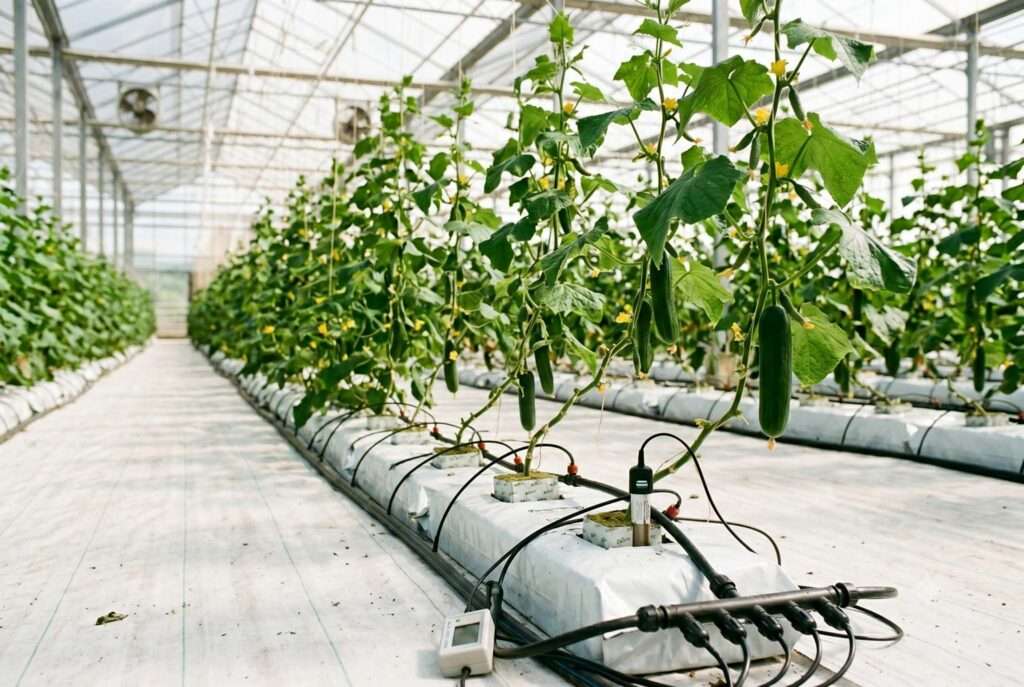

Cucumber Substrate Management Strategies
5 Greenhouse Cucumber Substrate Management Strategies That Actually Transform Your Yields
If you grow cucumbers commercially in a greenhouse, you already know the margin for error is thin. One bad batch of substrate, one poorly managed watering cycle, or a grow bag that drains too fast. You are looking at weeks of uneven growth and a harvest that falls short. Greenhouse cucumber substrate management is not just about filling bags and irrigating. It is the foundation of everything.
Let me walk you through five strategies that serious cucumber growers are using right now, from the Netherlands to South Korea, to get consistent, high-quality production cycle after cycle.
Why Substrate Choice Changes Everything for Cucumber Crops
Cucumbers are thirsty, fast-growing plants. In a commercial greenhouse setting, they can reach several meters in height within weeks, and that pace demands a substrate that can keep up, both in water retention and aeration. Traditional soil is simply too unpredictable at scale. That is why so many growers have shifted toward coir-based systems.
Coco coir, derived from coconut husk fibers, has become the go-to growing medium for cucumber production across Asia, Europe, and North America. According to the International Coconut Community (ICC), coir pith is one of the most sustainable alternatives to peat moss, with a natural pH that sits between 5.5 and 6.5, almost perfectly suited for cucumber root development.
Here is what makes it practical, not just popular: coir retains moisture well without becoming waterlogged, and that balance is exactly what cucumber roots need to stay healthy and actively absorb nutrients throughout the growing season. The physical structure of coir also resists compaction over long growing cycles, which means your second and third flushes are not penalised by a substrate that has collapsed on itself.
1. Match Your Substrate Density to Cucumber Root Behaviour
This is the step many growers skip, and it costs them. Cucumbers develop a shallow, wide-spreading root system rather than a deep taproot. That means the substrate density in your grow bags needs to support lateral expansion, not just downward growth.
For commercial cucumber production, a substrate with a bulk density of around 70 to 90 grams per litre tends to give the best results. Too dense, and you restrict oxygen penetration. Too light, and the plant tips in the bag before it establishes properly.
Coco peat grow bags with a pre-compressed format allow you to control the expansion rate during pre-soaking, which gives you more precision over final density than loose-filled alternatives. I have worked with growers who started adjusting their pre-soak volumes specifically to hit that 80 g/L sweet spot, and the root health improvement was visible within the first two weeks.
What Proper Hydration Protocols Look Like in Practice
Before you even place a cutting, your substrate preparation matters enormously. Rushing the pre-soaking process is one of the most common mistakes in greenhouse cucumber substrate management. Honestly, it is an easy one to make when you are setting up a large run and time is tight.
For coir-based grow bags, a proper buffering soak with calcium and magnesium solution, typically at around 3 to 4 EC, for a minimum of 24 hours, allows the coir to stabilise its cation exchange capacity. Skip this, and your early-stage fertigation will deliver less nutrition to the plant than your readings suggest. The coir will be pulling calcium out of your nutrient solution before the roots can access it.
You know what happens next: calcium deficiency in the fruit tips, blossom end problems, and a head start on physiological disorders that are hard to reverse mid-cycle.
2. Drainage Management: The Underrated Factor in Cucumber Substrate Performance
Most growers think about drainage in terms of avoiding waterlogging. But in high-production cucumber greenhouses, drainage management is actually about controlling the moisture tension inside the substrate throughout the day, not just preventing pooling.
Cucumber plants are most efficient at water uptake when the substrate moisture tension sits between 5 and 15 kPa. Below that, you risk anaerobic conditions at the root zone. Above it, the plant starts closing stomata to conserve moisture, and your assimilation rate drops.
A well-designed coco grow bag with the right drainage slits placed at the base will cycle the substrate through that tension range naturally across an irrigation cycle. Placement matters: slits that are too high retain excess moisture, while slits cut too low can cause nutrient leaching before roots can absorb adequately.
Commercial growers in Japan and the Netherlands typically run 6 to 8 short irrigation pulses per day during peak summer production, rather than two or three long ones. Short pulses keep the moisture tension in range without saturating the medium. It is a different mindset from field growing, but once you adjust, the results are hard to argue with.
3. Managing EC and pH Across the Cucumber Growth Stages
A cucumber crop is not a static system. The plant’s nutritional demands shift significantly from the vegetative phase through to heavy fruiting, and your substrate management needs to shift with it.
During early vegetative growth, cucumbers prefer a lower EC in the root zone, around 2.0 to 2.5 mS/cm, to encourage rapid root colonisation throughout the substrate. Push EC too high at this stage and you stress the root tips, which slows establishment.
As fruiting begins, particularly once you are harvesting consistently, EC can be raised to 3.0 to 4.0 mS/cm to support the increased calcium, potassium, and boron demand from developing fruit. Getting this transition wrong is where many otherwise well-managed operations lose yield quality.
Coir-based products from Sri Lanka have become widely trusted in high-precision growing systems specifically because washed and buffered coir provides a consistent, chemically inert base that does not interfere with EC and pH management the way some other organic substrates can.
4. Grow Bag Configuration for High-Density Cucumber Systems
Commercial cucumber greenhouses often run high-wire systems where plants are trained vertically and spaced to maximise light interception across a large canopy. In these systems, the grow bag configuration (length, volume, and plant spacing per bag) has a direct impact on root competition and therefore on yield per plant.
For high-wire cucumber production, a minimum bag volume of 10 to 12 litres per plant is generally recommended. This is not just about water holding capacity. It is about giving the root system enough physical space to avoid the competition that reduces nutrient uptake efficiency late in the season.
Growers running at 2 plants per bag should be working with at least 20 litres of usable substrate volume. If you have seen late-season yellowing that starts from the lower canopy and climbs upward, root restriction in an undersized bag is often the cause, even when your fertigation looks correct on paper.
Our customers at Coco Peat Coir Mulch have shared feedback about running high-wire cucumber systems in South Korea with our grow bags, noting that the consistent density and moisture distribution made it easier to maintain crop uniformity across long greenhouse rows. That kind of uniformity matters enormously when you are managing a commercial operation where every row needs to perform the same way.
5. Substrate Renewal and Crop Turnover Management
Coir substrates can typically support two full cucumber cycles before replacement becomes necessary, though this depends heavily on how well the substrate is maintained during the first cycle. By the end of a long fruiting season, coir will have accumulated salt deposits, root residue, and in some cases low-level pathogen populations that you do not want to carry into the next planting.
Between cycles, a thorough fresh water flush at high volume, targeting a leachate EC below 1.0 mS/cm, is the minimum standard. Some growers apply a hydrogen peroxide solution flush to reduce microbial load before disposal or composting. Coir substrate from a completed crop is an excellent soil amendment for open-field applications, so there is a useful end-of-life pathway that reduces waste.
For growers who want to eliminate carryover risk entirely, starting each new cucumber cycle with fresh grow bags is the cleanest approach. For high-value crops or certified production systems, this is often the right call regardless of cost.
Choosing the Right Coir Product for Commercial Cucumber Production
Not all coir grow bags are created equal, and the sourcing region matters more than many growers realise. Sri Lanka produces some of the world’s highest-quality coir fibre, processed from mature coconut husks with lower lignin content and better moisture consistency than coir sourced from younger palms.
When evaluating grow bags for cucumber production, look for products that specify:
- EC below 1.0 mS/cm pre-soak (indicates thorough washing)
- pH between 5.5 and 6.5
- Wettability data (how quickly the substrate rehydrates after dry-down)
- Consistent compression weight (a sign of uniform density across the batch)
These are not premium specifications. They are the minimum standard for a substrate that will not cause problems mid-cycle.
Frequently Asked Questions
- How often should I replace coir grow bags in a cucumber greenhouse?
For commercial cucumber production, coir grow bags typically support one to two full growing cycles. If you are running two cycles per year, annual replacement gives you a clean start and eliminates accumulated salt and pathogen risk. High-output systems with year-round production may benefit from per-cycle replacement.
- What is the best EC level for cucumber substrate management in coir grow bags?
During early vegetative growth, target an EC of 2.0 to 2.5 mS/cm in the root zone. Once fruiting is established, raise EC to 3.0 to 4.0 mS/cm to support fruit development. Monitor leachate EC regularly to ensure salts are not accumulating beyond target levels.
- Can I use the same substrate management approach for cucumbers and tomatoes in the same greenhouse?
Cucumber and tomato crops share similar preferences for coir-based substrates, but their irrigation frequency and EC targets differ. Cucumbers generally prefer more frequent, lighter irrigation pulses. Running both crops in the same greenhouse is possible, but managing them on separate irrigation schedules will give better results than a unified programme.
- Why is coir from Sri Lanka considered higher quality for commercial greenhouse use?
Sri Lankan coir is processed from mature coconut husks, which tend to have a more stable fibre structure and lower salt content than coir from younger palms. The processing industry in Sri Lanka also has well-established washing and buffering standards that make the product more consistent for precision growing systems.
- How do I prevent substrate compaction in coir grow bags over a long cucumber season?
The main causes of coir compaction are over-irrigation leading to continuous saturation, and physical compression from root mass buildup late in the season. Using a properly graded coir blend with some perlite or coarser husk chips can help maintain structure. Managing irrigation to allow periodic dry-back also keeps the substrate from becoming compressed over time.
