



 +94 (0) 31 228 1114
  info@cocopeatcoirmulch.com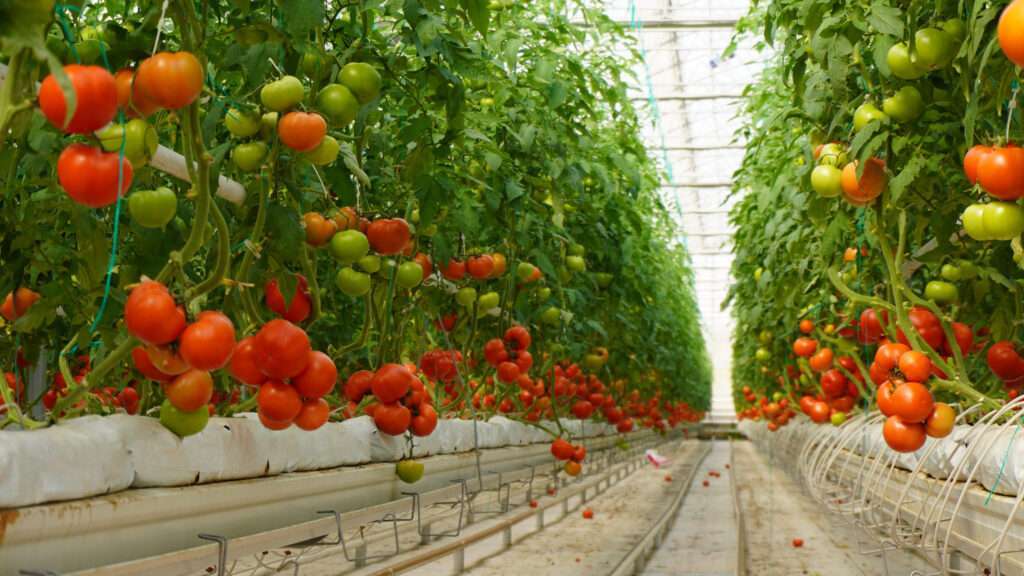

Greenhouse Tomato Substrate Performance in Commercial Production
7 Proven Ways to Improve Greenhouse Tomato Substrate Performance in Commercial Production
Commercial tomato growing in a greenhouse leaves almost no room for guesswork. When you are managing thousands of plants across a long season, greenhouse tomato substrate performance becomes one of the most critical variables you control. Get it right and your crop produces consistently from first truss to last. Get it wrong and you spend the season chasing problems that started underground.
This guide covers seven strategies that commercial tomato growers in the Netherlands, South Korea, Japan, Canada, and the USA are using to get more predictable, higher-quality output from coir-based growing systems.
Why Tomatoes Are Particularly Demanding on Substrate
Tomatoes are heavy feeders with a long production cycle. In a commercial greenhouse, a single indeterminate tomato variety can stay in production for nine to twelve months, producing truss after truss if the root environment stays healthy throughout. That is a long time to ask any substrate to maintain its structure, drainage characteristics, and cation exchange capacity.
This is exactly where coir shines. According to the Coconut Coir resource maintained by the International Coconut Community, coir pith offers exceptional water-holding capacity alongside adequate drainage, which is the balance tomato roots genuinely need. Unlike some synthetic substrates, coir maintains its physical structure across extended growing cycles, making it practical for the long seasons that commercial tomato production demands.
1. Select the Right Grow Bag Volume for Your Tomato Variety
Not all tomato varieties have the same root mass requirements, and this directly affects which substrate volume you should be working with. Large-fruited beefsteak varieties develop significantly more root biomass than cherry or cocktail types, and providing insufficient substrate volume restricts late-season performance.
For most commercial indeterminate varieties, a minimum of 15 to 18 litres of coir substrate per plant gives roots enough space to colonise fully through the season. Some Dutch-style high-wire operations use bag volumes of up to 20 litres per plant for the heaviest-producing varieties.
Grow bags for tomato production designed specifically for this crop tend to have elongated profiles that match the horizontal spacing of high-wire systems, distributing root growth evenly along the row rather than concentrating it under the planting hole.
Getting the Pre-Soaking Protocol Right From the Start
Here is something that separates experienced substrate managers from growers who are still troubleshooting in week three: the pre-soaking protocol is not optional, and it is not just about getting the substrate wet.
Coir has a natural cation exchange capacity that binds calcium and magnesium. Before any plant goes into a bag, the substrate needs to be buffered with a solution containing both elements, typically at a concentration of 3 to 4 EC, for a minimum of 24 hours. This saturates the exchange sites in the coir so your irrigation solution can deliver calcium and magnesium to the roots rather than losing them to the substrate.
Skipping this step or rushing it is one of the most reliable ways to trigger blossom end rot in your first truss. And once you see that, you are already behind.
2. Manage Drainage Slits to Control Moisture Tension
The drainage slit configuration in a tomato grow bag controls how quickly excess water exits the substrate and how long moisture is retained in the root zone. For tomatoes, the optimal substrate moisture tension is between 10 and 20 kPa throughout most of the growing cycle, dropping slightly during periods of high light and high evaporative demand.
Bags with drain slits positioned 1 to 2 cm from the base retain a small reservoir of nutrient solution at the bottom, which acts as a buffer during peak demand periods. This matters especially in summer months when tomato plants in full production can pull significant volumes of water per day from the root zone.
Some growers in South Korea and Japan have reported to us that adjusting drain slit height seasonally, using a simple external tape-over approach on higher slits during winter production, gave them better moisture retention during low-radiation periods without any modification to irrigation scheduling.
3. Calibrate EC Targets Across the Full Tomato Production Cycle
Tomato EC management is not a set-and-forget exercise. The plant’s relationship with electrical conductivity changes from propagation through to the final weeks of harvest, and your substrate strategy needs to reflect that.
During propagation and early establishment, a root-zone EC of 2.0 to 2.5 mS/cm encourages rapid root extension through the substrate. Push this too high at transplant and you stress developing root tips before they can establish properly.
Through the main fruiting phase, most commercial tomato programmes operate at 3.0 to 4.5 mS/cm in the root zone, with some growers running higher EC in summer to compensate for higher water uptake diluting the solution. In winter production under supplemental lighting, some Dutch operations work at EC values as high as 5.0 to 6.0 mS/cm to concentrate flavour compounds in the fruit.
Sri Lanka’s coir industry produces washed and buffered substrates with a base EC below 1.0 mS/cm, which is important because a high-EC substrate straight from the bag constrains your ability to manage fertigation precisely from day one.
4. Monitor Leachate to Diagnose Root Zone Issues Early
One of the most practical habits in greenhouse tomato substrate management is regular leachate monitoring. Collecting drain water from your bags and measuring its EC and pH takes less than two minutes per sample, but it tells you things about your root zone that visual inspection never will.
A leachate EC significantly higher than your input solution indicates salt accumulation in the substrate. Left unaddressed, this raises osmotic pressure in the root zone and progressively reduces water and nutrient uptake, showing up first as reduced fruit size and increased tip burn on leaves.
A leachate pH that drifts above 6.8 or below 5.5 suggests the substrate is interacting with your nutrient solution in ways that will lock out specific elements. Calcium and magnesium become less available above pH 6.5. Iron and manganese availability drops sharply above 6.8.
Running weekly leachate checks and keeping a simple log takes minimal time. Growers who do this consistently catch problems weeks before they appear in the canopy.
5. Understand Coir Particle Size and Its Effect on Tomato Root Development
Coir substrates are not all the same physical product, even when they look similar. The particle size distribution inside a grow bag affects aeration, water retention, and how easily tomato roots can extend through the medium.
A well-graded coir substrate for tomato production typically contains a blend of fine pith, medium chips, and coarser fibres. The pith component holds moisture and nutrients. The chip and fibre fraction creates macro-pores that retain oxygen after irrigation. When the balance shifts too far toward fine pith, the substrate retains excess moisture and oxygen levels drop. When it shifts too far toward coarse chips, the medium dries too quickly between irrigations.
Premium coir grow bags from Sri Lanka are produced to specified particle size distributions, which makes performance more predictable across batches than loose-filled or self-mixed alternatives. Our customers growing beefsteak tomatoes for premium retail markets in Europe have found that batch consistency in the substrate makes crop uniformity significantly easier to achieve across long rows.
6. Manage Substrate Temperature for Year-Round Production
Root zone temperature is an underappreciated factor in greenhouse tomato substrate performance, particularly for growers in climates with cold winters or very hot summers.
Tomato roots perform best in a substrate temperature range of 18 to 22 degrees Celsius. Below 15 degrees, phosphorus uptake is significantly impaired even when phosphorus is present in the solution at correct levels. Above 28 degrees, oxygen solubility in the soil solution drops and root respiration is disrupted.
In northern European and Canadian greenhouses during winter, grow bags placed directly on cold concrete floors can run 4 to 6 degrees below ambient air temperature. Raising bags onto polystyrene slabs or purpose-made plastic tray supports is a low-cost intervention that makes a measurable difference to early-season establishment.
In Middle Eastern or hot-climate operations, heat build-up in substrate during summer can be managed by increasing early-morning irrigation frequency to cool the root zone. Coir’s thermal buffering capacity helps here, but it has limits.
7. Plan Your Substrate Changeover Timing for Minimum Crop Disruption
The end of a long tomato season is the moment when substrate management decisions made nine months earlier become visible. Coir that was properly managed throughout the cycle will still be structurally sound at removal. Substrate that suffered repeated over-saturation, high salt accumulation, or poor drainage will be compacted and root-bound.
Plan your bag changeover as part of your crop scheduling, not as an afterthought. For double-cropping systems, the window between removing one crop and transplanting the next is often tight, and having fresh bags pre-ordered and ready eliminates the temptation to reuse substrate that should be composted.
A complete fresh water flush of remaining substrate before removal simplifies disposal. Spent coir is an excellent soil amendment for field agriculture and can often be given to local farmers at no cost, which reduces disposal overhead.
Choosing a Reliable Substrate Supplier for Commercial Tomato Production
For commercial-scale operations, supply consistency matters as much as product quality. A substrate that performs well in one batch but varies significantly in the next creates crop variability that is difficult to manage.
Coir-based product exporters in Sri Lanka with established export infrastructure and batch testing can provide the documentation most commercial greenhouse operations require. Look for suppliers who can provide EC, pH, and particle size specifications per batch, not just generic product descriptions.
When evaluating new substrate suppliers, always trial one greenhouse section before committing to a full season’s supply. A two-truss comparison between your current substrate and a new product tells you far more than a specification sheet.
Frequently Asked Questions
- What substrate volume is recommended for commercial indeterminate tomatoes in coir grow bags?
Most commercial indeterminate tomato varieties perform well with 15 to 18 litres of coir per plant. Heavy-producing beefsteak types may benefit from up to 20 litres. Providing sufficient substrate volume reduces root competition late in the season when plant demand is highest.
- How do I know if my tomato substrate is accumulating excess salts?
The most reliable indicator is leachate EC that is consistently higher than your input solution EC. A healthy target is leachate EC within 0.5 to 1.0 mS/cm above input. If leachate EC is running 2.0 or more above input, a fresh water flush of the bags is recommended to prevent root zone salt stress.
- Can coir grow bags be reused for a second tomato season?
In principle, coir can support two seasons with proper management. In practice, commercial operations with high yield targets often choose to start each season with fresh substrate to eliminate carryover disease and salt accumulation risk. For certified or premium production, fresh substrate per cycle is the standard.
- Why is coir preferred over rockwool for some commercial tomato growers?
Coir offers several practical advantages. It is a natural, renewable material with straightforward disposal via composting or field amendment. It has buffering capacity for pH and moisture that some growers find more forgiving than rockwool under variable growing conditions. Coir also tends to have a lower initial cost than high-grade rockwool slabs.
- What is the ideal substrate temperature for tomato roots in a coir grow bag?
Tomato roots perform optimally between 18 and 22 degrees Celsius. Below 15 degrees, phosphorus uptake is impaired regardless of solution concentration. Insulating grow bags from cold floors during winter and managing early-morning irrigation frequency in hot climates are the two most effective interventions for keeping root zone temperature in the optimal range.
