



 +94 (0) 31 228 1114
  info@cocopeatcoirmulch.com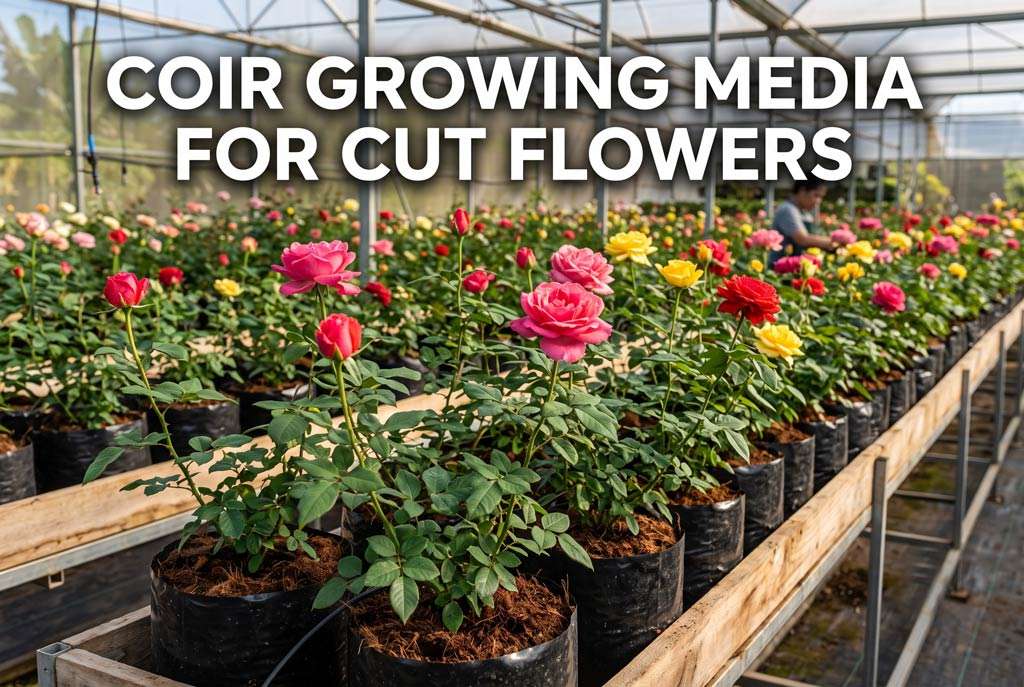

8 Reasons Coir Growing Media for Cut Flowers Keeps Gaining Ground
8 Reasons Coir Growing Media for Cut Flowers Keeps Gaining Ground
Cut flowers punish a substrate in a way vegetables never do. A tomato crop finishes and the slab gets replaced. A rose crop sits in the same root zone for two, three, sometimes five years, and every weakness in that material shows up eventually as shorter stems and thinner necks. That long horizon is exactly why coir growing media for cut flowers has moved from an experiment to a default across so many production regions.
Let me explain what changed, because it was not one dramatic breakthrough. It was a slow accumulation of small wins that growers noticed and told each other about.
Long Crops Punish the Wrong Root Zone
Think about what happens to a substrate over three years of continuous fertigation.
Organic components break down. Particle structure collapses. Air-filled porosity drops, which means roots that were happy in year one are gasping by year three. pH drifts. Salts accumulate in pockets. And because the crop is still standing, you cannot fix any of it without pulling out plants you have spent years training.
That is the actual problem cut flower growers wrestle with, and it explains why mineral substrates held the market for so long. Rockwool does not decompose. Neither does perlite.
Coconut fibre changed the calculation because of its lignin content. The material resists microbial breakdown far better than sphagnum peat, which means it keeps its physical properties across a long crop cycle instead of quietly turning to mush. The chemistry behind that durability is covered well on the coir reference page, and it is the same property that makes coconut fibre useful in ropes and mats that sit outdoors for years.
What the Rose Trials Actually Showed
Numbers help here more than enthusiasm.
Cut roses grown for two years in a recirculating system, comparing coconut fibre against granulated rockwool, produced around fifteen point six percent more marketable stems over thirty centimetres in the first year. Fresh weight came in roughly eighteen percent higher. Micro element levels in the harvested stems ran higher in the coir treatment too.
Trials on gerbera have pointed the same direction, with coconut fibre appearing repeatedly among the peat alternative substrates that hold up under long ornamental production.
Here is the honest caveat though. Those results came from well managed systems with fertigation adjusted for the substrate. Drop coir into a programme designed around rockwool and change nothing, and you will get a disappointing first year and blame the wrong thing.
Eight Reasons Coir Growing Media for Cut Flowers Keeps Winning Growers Over
Pulling the practical arguments together:
- Physical structure holds across multi-year crops rather than collapsing
- Higher air-filled porosity at container capacity than most peat-based mixes
- Rewets readily, so a dry-down event does not become a hydrophobic disaster
- High cation exchange capacity, which steadies nutrient availability between feeds
- Root temperature stays more even, which matters in high-light regions
- End of crop disposal is straightforward, since the material composts
- Blend ratios can be tuned per crop instead of accepting one fixed product
- Supply is renewable and comes from an agricultural by-product rather than an extracted resource
That last point has stopped being a soft argument. European buyers now ask about it directly, and several large flower retailers have written substrate sourcing into their supplier requirements.
Gerbera, Rose and Carnation Want Different Mixes
This is the part that gets flattened in most sales conversations, and it costs growers yield.
| Crop | Suggested blend | Container style | Typical cycle |
| Rose | Fine pith heavy, roughly 80/20 with chips | Slab or trough | 3 to 5 years |
| Gerbera | Balanced, around 70/30 pith to chips | Individual containers | 2 to 3 years |
| Carnation | Open mix, 60/40 with coarser fraction | Raised bed or trough | 18 months to 2 years |
| Orchid | Chip dominant, 30/70 pith to chips | Pots with free drainage | 3 years plus |
| Chrysanthemum | Fine pith heavy | Beds or troughs | 10 to 14 weeks per cycle |
| Tulip and bulbs | Fine pith with sand or perlite | Trays and crates | Single forcing cycle |
Roses like moisture and tolerate a wetter root zone than most people expect, which is why fine pith dominates their mixes. Orchids want the opposite, with air moving freely around the roots and moisture held only in the chips. Get those two backwards and you will spend a season fighting your irrigation controller.
Air and Water Decide Stem Length
Every cut flower buyer pays for stem length and stem strength. Both trace back to root zone conditions during the weeks when that stem was forming.
Too wet and roots slow down, nutrient uptake drops, and stems come short and soft. Too dry and the plant shifts into survival mode, which also shortens stems. The window between those two states is what a good substrate widens for you.
Coconut fibre widens it in a specific way. It holds a substantial water reserve while keeping air spaces open, so the plant has access to moisture without sitting in it. In practical terms, growers report fewer emergency interventions when a pump fails or a hot afternoon arrives unexpectedly.
Our customers are really happy with how forgiving the material is during heat events, and a gerbera grower in the Netherlands described it this way: “We lost a fertigation cycle on the hottest day last July and the crop barely noticed. That would have cost us a week of production before.”
Feeding a Long Flower Crop
Because coconut fibre has a high cation exchange capacity, it participates in your nutrition programme rather than sitting passively.
Calcium and magnesium deserve early attention. Potassium behaviour shifts slightly compared with mineral substrates. Most growers making the switch adjust their recipe rather than rebuilding it, and the change is usually made in the first six weeks based on drain analysis.
Watch drain EC daily during establishment. It will tell you more about what the substrate is doing than any specification sheet. Once the crop settles, weekly monitoring is generally enough.
One tangent worth mentioning, since it comes up constantly. Recirculating systems and coconut fibre work well together, but only if you are analysing the returned solution properly. Sodium accumulation over a multi-year crop is manageable when you are watching for it and irritating when you are not.
Container, Slab or Bed?
Format matters as much as blend.
Individual containers suspended at working height suit gerbera especially well. Each plant has its own root zone, disease spreads more slowly, and harvesting posture improves for the team, which sounds minor until you count the labour hours.
Slabs and troughs work for roses and carnations where plant density is high and a shared root zone is acceptable. Formats similar to the coco peat grow bags used in vegetable production adapt to flowers with adjusted blend ratios.
Open top and planter formats suit crops that stay in place for years and need surface access for topping up or root inspection. Growers working with woody ornamentals or large specimen plants often prefer open top planter bags for exactly that reason.
Bed systems still exist in some regions and work fine, though they make substrate replacement a much bigger job when the time comes.
There is a labour angle here that rarely makes it into substrate discussions. Individual containers cost more per plant to set up, but they let you remove and replace a single failing plant without disturbing its neighbours. In a rose house running five years, that flexibility adds up. Slabs are cheaper to install and cheaper to replace wholesale, yet a disease pocket in the middle of a trough means pulling more plants than you would like. Neither answer is universally right, and the decision usually comes down to how long you intend to keep the crop standing and how much your local labour costs.
What Growers in Kenya, Ecuador and the Netherlands Ask First
The questions differ by region, which tells you something about local conditions.
Kenyan and Ethiopian rose growers ask about water holding and heat behaviour, because their light levels and temperatures are punishing. Ecuadorian and Colombian growers ask about altitude effects and consistency of supply, since freight schedules matter enormously to them. Dutch growers ask about certification, recirculation behaviour and precise physical specifications.
I have used the same trial structure in all three settings. Two benches or two rows on the new substrate, same cultivar, same feed, change only the irrigation timing, then compare stem grade at first harvest. It removes the argument from the conversation and replaces it with numbers, which is where these decisions should be made anyway.
Buying Without Regretting It
A few things to establish before the first container arrives.
Ask for the blend ratio as a percentage, not a description. Ask for electrical conductivity figures from actual production batches. Confirm the expansion ratio, since it determines pallet counts and store space. And ask how many separate mills feed the supply chain, because material blended from many small sources varies more than material from a controlled route.
Then run a trial before converting a whole house. Flower crops are long, and a mistake compounds for years rather than months.
Lead time deserves a mention too. Coconut fibre travels by sea from producing countries, and a container takes weeks rather than days. Nurseries that plan substrate orders around planting dates rather than around shipping schedules end up paying for air freight or delaying a crop. Neither is fun. Build the transit window into your planning calendar and the whole thing becomes routine.
Frequently Asked Questions
Is coconut fibre better than rockwool for roses?
Trial data on cut roses in recirculating systems has shown higher marketable stem counts and greater fresh weight from coconut fibre in the first production year. Results depend heavily on fertigation being adjusted for the substrate, so the material alone is not the whole story.
How long does coir last in a cut flower crop?
Most rose crops run three to five years in the same substrate. Gerbera commonly runs two to three. The limit is usually structural collapse and salt accumulation rather than any fixed lifespan.
Which blend suits orchids?
Chip dominant mixes, often around thirty percent fine pith to seventy percent chips, since orchid roots need air movement far more than they need held moisture. Pure fine material tends to stay too wet for most epiphytic species.
Does coconut fibre work in recirculating systems?
Yes, and it is widely used that way in European glasshouses. Regular analysis of the returned solution matters, particularly for sodium accumulation over long crops, but the material itself poses no barrier to recirculation.
Can I use vegetable grow bags for flowers?
Often yes, with an adjusted blend. The physical format frequently transfers directly while the pith to chip ratio changes to suit the crop. Roses want a finer mix than tomatoes; carnations want a coarser one.
