



 +94 (0) 31 228 1114
  info@cocopeatcoirmulch.com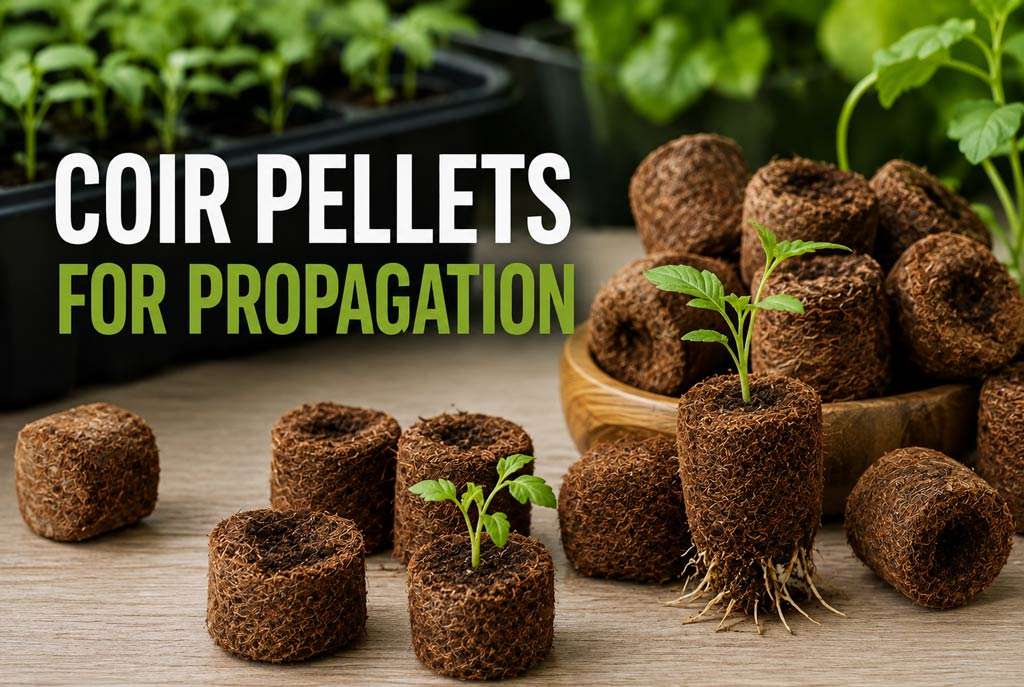

7 Ways Coir Pellets for Propagation Lift Your Strike Rate
7 Ways Coir Pellets for Propagation Lift Your Strike Rate
Ask any propagator where a crop is most likely to fail and you will get the same answer. Not harvest. Not mid-season. The first fortnight. Seeds that never wake up, cuttings that rot at the base, seedlings that stall for no visible reason. That two week window decides your whole schedule, which is why coir pellets for propagation have quietly become standard equipment in nurseries that used to fill their own trays by hand.
Here is the thing though. Plenty of growers still think of them as a convenience product. They are actually a consistency product, and that distinction matters.
The Weakest Link Is Usually the First Two Weeks
A propagation medium has an awkward job. It has to hold enough water that a tiny root system never dries out, while holding enough air that the same root system never suffocates. Those two demands pull against each other, and the margin for error shrinks the smaller the plant is.
Hand-filled trays make this harder than it needs to be. One person packs firmly, another packs loosely, and suddenly half your tray drains differently from the other half. You end up watering to the wettest cells, which drowns the rest.
Compressed pellets solve that by being identical. Same density, same volume, same behaviour, cell after cell after cell. It sounds like a small thing. Across a hundred thousand cells it is not.
What a Coir Pellet Actually Is
Strip away the marketing and it is compressed coconut pith, usually held in a fine mesh or wrap, pressed into a disk that expands into a cylinder when you add water.
The pith comes from coconut husk, a by-product of fibre extraction. Sri Lanka has been running that process commercially for well over a century, and the Sri Lankan coir industry supplies propagation and growing media into Europe, North America and across Asia. Long history means settled grading conventions, which is exactly what you want in a product where consistency is the entire point.
A dry disk sits about eight to twelve millimetres thick. Add water and it swells to three or four times that height in under a minute. That expansion is the whole trick, because it means you ship air rather than volume.
Seven Ways Coir Pellets for Propagation Change a Nursery Week
Practical gains, in the order propagators tend to notice them.
- Uniform density across every cell, which means one watering decision instead of dozens
- Faster tray setup, since filling, levelling and firming disappear from the workflow
- Less transplant shock, because the root ball moves intact with nothing to disturb
- Cleaner benches, as there is no loose medium spilling during handling
- Predictable water behaviour, so irrigation can be automated with confidence
- Reduced storage footprint, with compressed disks taking a fraction of the space
- Simpler seasonal scaling, since you order units rather than estimating bulk volume
Number three is the one with the biggest downstream effect. Roots that never get torn during transplant establish faster in the production container, and that shows up as days gained at the other end of the crop.
Disks, Plugs and Pellets: Sorting Out the Formats
The terminology gets used loosely, which causes confusion at order stage.
| Format | Dry size | Expanded size | Wrapped? | Best suited to |
| Small disk | 22 to 25 mm | 25 x 30 mm | Mesh | Small seed, herbs, leafy greens |
| Standard disk | 35 to 38 mm | 38 x 42 mm | Mesh | Vegetable seedlings, bedding plants |
| Large disk | 45 to 50 mm | 50 x 55 mm | Mesh | Cucurbits, larger seed |
| Grow cube | 40 x 40 mm | Minimal change | Unwrapped | Cuttings, grafting, hydroponic starts |
| Loose fill pellet | 20 to 30 mm | 30 to 40 mm | None | Systems where netting is unwanted |
| Bulk pressed block | Varies | Varies | None | Nurseries filling their own trays |
Growers who prefer to fill their own trays but still want consistent material often work from bulk formats and press in house. That route trades convenience for control, and for some operations the arithmetic favours it.
Netting, Wrapping and the Root Escape Question
Most pellets use a fine mesh to hold their shape once hydrated. Without it, a wet pellet slumps.
That mesh is worth asking about. Some are made from materials that break down in soil within a season. Others persist far longer, which becomes a problem if the plant is going into open ground or if the operation has organic certification to think about.
Roots will grow through the mesh, which is intended. What you do not want is a mesh tight enough to girdle a stem or dense enough to slow root escape at the critical moment. If you have ever pulled a transplant six weeks later and found roots spiralling inside the wrapper, you have met a mesh that was too tight.
Unwrapped cubes avoid the question entirely, though they need gentler handling. Choose based on how much automation touches the product between propagation and planting out.
Worth mentioning a related detail that catches people out at scale. If your transplanting line uses grippers or vacuum heads, mesh-wrapped pellets generally handle the mechanical stress better than unwrapped material, which can crumble at the shoulders. Hand-transplanting operations have more freedom. It is a small compatibility question, but finding it out after a container has landed is an expensive way to learn.
Watering a Tray of Pellets Without Drowning It
Coconut pith holds a lot of water. That is a feature until someone treats a pellet tray like a tray of peat plugs.
The practical guidance most propagators arrive at:
- Hydrate fully before sowing, then let the surface dry slightly before seed goes in
- Water little and often rather than flooding, since pellets rewet easily
- Bottom watering suits mesh-wrapped formats well and keeps the crown dry
- Watch the base of the tray, because standing water is the fastest route to damping off
Honestly, the most common mistake is overwatering in week one out of anxiety. The material forgives a slightly dry pellet far more readily than a permanently saturated one.
I have used this with a bedding plant nursery that had been losing cells to damping off every spring. We changed nothing except moving to bottom watering on a strict schedule and letting the surface dry between passes. Losses dropped noticeably within two cycles, and nobody had to buy new equipment.
From Pellet to Production Container
The handover is where propagation quality either pays off or gets wasted.
A rooted pellet should go into its production container with the root ball intact and the top of the pellet sitting just below the surface of the surrounding medium. Leave it proud and the exposed mesh wicks moisture away, drying the root ball while everything around it stays wet. That single detail causes more early losses than most people realise.
Matching the propagation medium to the production medium helps too. Coconut pith into coconut pith means no abrupt change in water behaviour at the interface, which is one less shock for a young root system. Operations running vegetable crops into formats like grow bags for tomato usually find the transition smoother when both stages share the same base material.
Soft fruit follows the same logic. Runners and young plants started in coconut pith and moved into grow bags for strawberry establish without the check you sometimes see when the two media behave differently.
Timing the move matters as much as the technique. Too early and the root ball has not knitted, so the pellet falls apart in the hand. Too late and roots spiral inside the mesh, which sets the plant back for a fortnight after planting. The usual signal propagators watch for is white root tips just visible at the outer surface of the pellet, not a dense mat wrapping the whole thing. Once you learn to read that on your own crop, transplant timing stops being a guess and starts being a schedule.
What to Ask Before Ordering
Four questions that separate a good supplier from a frustrating one.
What is the expansion ratio, measured how? Ratios quoted without a method mean little. Ask for dry weight to hydrated volume under stated conditions.
What is the electrical conductivity? Young roots are sensitive, and residual salts in poorly washed material cause stalling that looks like disease.
What is the mesh made from and how long does it last? Especially important for organic production and open ground planting.
How consistent is batch to batch? Ask for records across several production runs rather than a single sample. Our customers are really happy with the run to run consistency they get, and a propagation manager in Canada put it neatly: “I stopped adjusting my watering schedule between orders, which tells you everything.”
Frequently Asked Questions
How long do coir pellets take to expand?
Most expand fully within thirty to sixty seconds of contact with warm water. Cold water slows it noticeably. Give the tray a few extra minutes and check the centre of a sample pellet before sowing, since the outside hydrates first.
Do coir pellets need fertiliser added?
Yes, in most cases. Coconut pith is largely inert and carries little inherent nutrition, so a starter feed is usually applied once the first true leaves appear. Some products come pre-charged with nutrients, which the specification should state clearly.
Can coir pellets be reused?
Not generally for a second propagation cycle, since the structure is disturbed and disease risk rises. Spent pellets compost well though, and many nurseries add them to soil improvement heaps rather than discarding them.
Are coir pellets suitable for cuttings as well as seed?
Yes, and unwrapped cubes are often preferred for cuttings because the stem can be inserted cleanly without mesh interference. Rooting hormone application and humidity control matter more than the medium in most cutting work.
What pellet size should I use for vegetable seedlings?
Standard disks expanding to roughly 38 by 42 millimetres cover most vegetable and bedding work. Larger seed such as cucurbits benefits from the 50 millimetre range, while fine seed and herbs do better in smaller formats where the root ball does not stay wet around a tiny plant.
