



 +94 (0) 31 228 1114
  info@cocopeatcoirmulch.com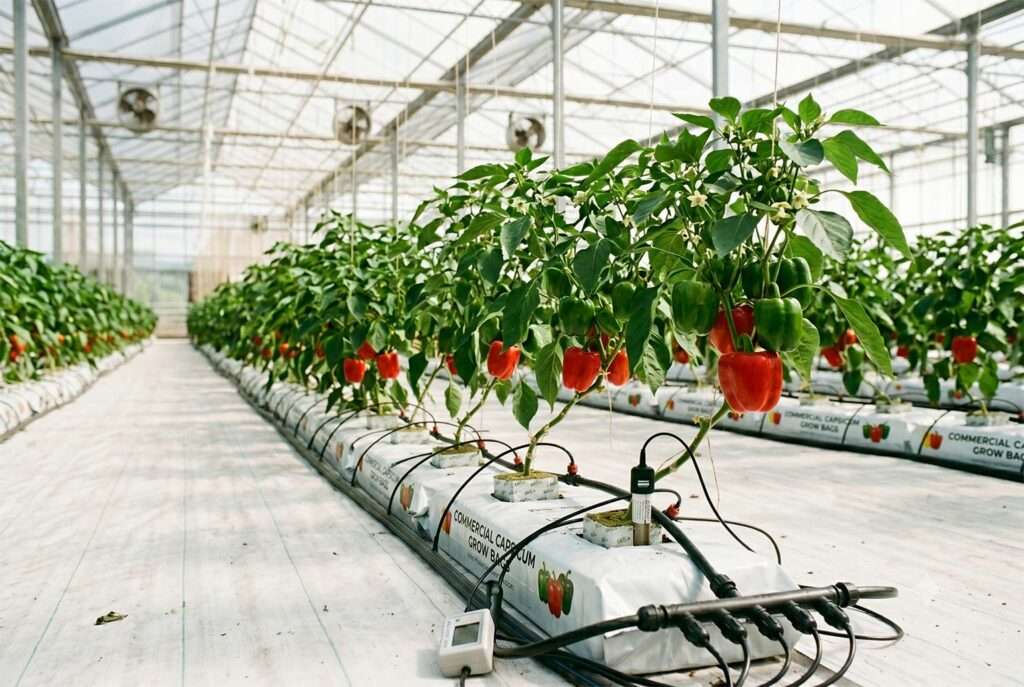

Growers Should Know About Commercial Capsicum Grow Bags Before Planting Season
6 Things Growers Should Know About Commercial Capsicum Grow Bags Before Planting Season
Capsicum production in a controlled greenhouse environment is rewarding when everything lines up, and genuinely frustrating when it does not. The crop has specific preferences for root temperature, moisture levels, and nutrient availability that differ enough from tomatoes and cucumbers to catch growers off guard the first time they switch or scale up. And more often than not, the issues that surface in the canopy trace back to decisions made about commercial capsicum grow bags before the first plant ever went in.
So before your next planting cycle starts, here are six things worth understanding about how grow bag selection and substrate management shape the outcome of a capsicum crop.
Why Capsicum Root Systems Behave Differently From Other Fruiting Crops
Capsicum plants develop a relatively fine, fibrous root system that is sensitive to both over-watering and moisture stress. Unlike tomatoes, which can tolerate brief periods of substrate saturation without significant root damage, capsicums will show early signs of root suffocation in persistently wet substrate. The roots need reliable oxygen availability throughout the growing cycle, not just at establishment.
This sensitivity is part of why the substrate inside your commercial capsicum grow bags matters so much. A coir blend that retains slightly too much moisture works well for cucumbers but creates conditions where capsicum root health deteriorates steadily over several weeks before the canopy gives any visible clue. By the time leaf cupping or reduced fruit set appears, root damage is already established.
According to coir industry research referenced by the International Coconut Community, coir pith when properly graded and processed provides an air-to-water ratio that suits a wide range of crops, including capsicum. The key is in the processing: poorly washed or unevenly compressed coir introduces variability that makes managing fine-rooted crops like capsicum harder than it needs to be.
1. Match Grow Bag Size to Your Capsicum Production System
Capsicum plants grown for commercial red, yellow, and orange fruit production have long production cycles, often running eight to ten months in a single season. Over that period, root mass develops significantly, and a bag that seems adequate at transplant can become restrictive by mid-season.
For commercial sweet pepper and capsicum production, a bag volume of 12 to 15 litres per plant is generally the working standard across the Netherlands, South Korea, and North American operations. Some growers running premium coloured capsicums in high-wire systems use volumes closer to 18 litres, particularly when the intention is to push high-yield targets through extended seasons.
Running two plants per bag is common, which means the physical bag should contain 25 to 30 litres of usable substrate. This configuration affects the spacing of planting holes, the drainage slit placement, and the irrigation emitter layout, so it is worth confirming your bag specification before the season begins rather than adapting mid-cycle.
2. Understand Why Coir Blend Composition Affects Capsicum More Than Other Crops
Here is where capsicum production diverges most clearly from standard grow bag recommendations. Because capsicum roots are so sensitive to oxygen levels in the root zone, the particle size distribution inside the bag is not just a quality consideration. It is a crop-specific requirement.
A coir substrate with a high proportion of fine pith holds moisture well but compresses over time, reducing macro-porosity and therefore oxygen availability. For a tomato crop that develops large, robust roots, this is manageable. For capsicum, it is a risk that compounds over a long season.
The practical solution is to specify a coir blend that includes a meaningful proportion of coir chips or medium-grade husk material alongside pith. A blend with roughly 30 to 40 percent chip fraction maintains structural integrity and oxygen levels through a full eight-month capsicum season. This is not a detail that every supplier communicates clearly, so it is worth asking for blend composition data when evaluating coco peat grow bags for capsicum production.
Getting Irrigation Right for a Crop That Does Not Forgive Wet Roots
Irrigation management for capsicum in coir grow bags is the area where most growers find their rhythm only after one difficult season. The instinct, especially for growers coming from tomato production, is to run a similar irrigation programme. But capsicums are not tomatoes.
The substrate moisture tension for capsicum should be maintained between 15 and 25 kPa through most of the production cycle. This is a drier range than tomato or cucumber targets. Running wetter than this consistently, even at 10 kPa, creates conditions that favour Phytophthora root rot, one of the most common and damaging problems in protected capsicum production.
Short, frequent irrigation pulses with a meaningful dry-back period overnight are the standard approach. In South Korea and Japan, where commercial capsicum production under glass is well-established, growers typically allow substrate moisture to drop to 20 to 25 kPa before triggering the first morning irrigation. This dry-back cycle is not stress; it is stimulus. It drives root development and keeps the oxygen level in the root zone where it needs to be.
3. Pre-Soak and Buffer Coir Before Capsicum Transplant
Capsicum plants are particularly sensitive to calcium and magnesium deficiency during early establishment. The first two to three weeks after transplant are when root tips are actively colonising the substrate and the plant is establishing the nutrient uptake capacity it will rely on for the rest of the season.
Coir’s natural cation exchange properties mean that an unbuffered substrate will bind calcium and magnesium from your irrigation solution before roots can access them. For capsicum, which has relatively low early water demand but high sensitivity to calcium availability, this initial competition can cause deficiency symptoms in expanding leaves well before you would expect them.
Buffering with a calcium-magnesium solution at 3 to 4 EC for 24 hours prior to transplant is the minimum standard. Some growers run a second buffering pass at lower concentration after the initial soak, which is particularly useful when using substrate that has been stored for an extended period.
4. Recognise the Signs That Your Substrate Is Restricting Your Capsicum Crop
Capsicum plants communicate substrate stress in characteristic ways, and recognising these signs early means the difference between correcting a problem in week four and managing a recovery programme for the rest of the season.
Leaf cupping or upward rolling in well-watered plants often indicates root zone oxygen stress, suggesting the substrate is staying too wet between irrigations. This can be a drainage slit issue, an over-irrigation issue, or a substrate compaction issue. It warrants investigation rather than simply increasing feed concentration.
Purpling of stems and the underside of leaves, outside of variety-specific colouration, often signals phosphorus lockout caused by root zone pH drifting above 6.5. In coir systems, this typically traces to insufficient buffering or a calcium excess in the feed that is elevating substrate pH.
Pale new growth with green veins, a classic iron deficiency pattern, points to pH above 6.8 or manganese competition. If your leachate pH is running above 6.5, adjusting the pH of your irrigation solution downward by 0.3 to 0.4 units will generally correct this within two weeks.
5. Plan Your Capsicum Substrate Strategy for Multiple Varieties
Many commercial greenhouse operations grow several capsicum varieties simultaneously, perhaps a mix of red, yellow, orange, and specialty types like long sweet peppers or pimento. Each variety has slightly different characteristics, but within a single greenhouse they will typically be managed on the same irrigation programme and same substrate specification.
This means your substrate choice needs to work across your range, not just for your primary variety. A substrate that is excellent for a vigorous, large-fruited red capsicum may be marginal for a less vigorous specialty type that has more moderate water demand.
Open top planter bags give you flexibility here because they allow substrate volume to be adjusted more easily per plant position than sealed standard grow bags. For mixed-variety operations, this can simplify management of varieties with different root volumes without requiring different bag sizes across the greenhouse.
6. End-of-Season Substrate Removal and Turnover Planning
Capsicum roots are finer and more pervasive than tomato roots, and they colonise the full bag volume by the end of a long season. Removing spent capsicum substrate takes more physical effort than cucumber or leafy green changeovers, and it is worth factoring this into your seasonal labour planning.
Coir from a well-managed capsicum season is a valuable agricultural amendment. Its fine structure and organic matter content make it useful for improving drainage and aeration in clay-heavy soils, and local farmers in growing regions from the Netherlands to Japan have found value in spent coir substrate when it is offered at low or no cost.
For the next capsicum season, starting with fresh bags eliminates two of the most common carryover risks: residual pathogen populations in the root mat and accumulated sodium from long-term fertigation. Sri Lanka’s coir export industry has developed consistent production standards that make sourcing fresh substrate per cycle economically practical even for medium-scale operations.
Some of our customers growing capsicum commercially in North America have switched from rockwool to Sri Lankan coir grow bags and noted that managing EC and moisture in the coir substrate was more intuitive, particularly for their team members who found the more visible physical state of coir easier to work with than the less tactile experience of rockwool slabs.
Building a Consistent Capsicum Substrate Programme
The growers who get the best results from capsicum in coir grow bags are typically those who treat substrate management as a continuous, season-long programme rather than a one-time decision made at the supply stage. That means monitoring leachate weekly, adjusting irrigation frequency with the seasons, and keeping records that allow you to compare performance across cycles.
For commercial capsicum operations sourcing substrate at scale, working with an established coir-based product exporter that can provide batch-specific EC and pH documentation removes one variable from what is already a complex crop. Consistency in the substrate makes every other management decision easier to interpret.
Frequently Asked Questions
- What size grow bag is recommended for commercial capsicum production?
For single-plant configurations, 12 to 15 litres per plant is the standard range. For two plants per bag, which is common in Dutch-style high-wire systems, 25 to 30 litres of total substrate gives adequate root volume for a full season. Larger bags become more relevant for long-season coloured capsicum varieties.
- Can the same coir grow bags be used for both capsicum and tomatoes in the same facility?
The same bag format can be used, but capsicum ideally benefits from a substrate blend with a higher chip fraction to maintain oxygen levels in the root zone. If you are sourcing one substrate for both crops, a medium-chip blend tends to be a reasonable compromise, though tomato production at maximum yield targets prefers slightly finer material.
- How often should I check leachate EC and pH in capsicum grow bags?
Weekly checks are the minimum for commercial production. During periods of high production or significant weather changes, twice-weekly checks allow faster identification of salt accumulation or pH drift. Capsicum is more sensitive than tomato to root zone chemistry changes, so the benefit of frequent monitoring is proportionally higher.
- Why does my capsicum crop show calcium deficiency even when calcium is in my nutrient solution?
Calcium deficiency in capsicums growing in coir most commonly traces to one of three causes: insufficient pre-soak buffering that left the cation exchange sites unsaturated, substrate pH above 6.5 limiting calcium uptake, or a root zone that is staying too wet and limiting transpiration-driven calcium movement into the plant. Check buffering protocol, leachate pH, and irrigation frequency before adjusting your feed formula.
- Is coir sustainable for large-scale commercial capsicum production?
Coir is produced from coconut husk, a by-product of the coconut processing industry that would otherwise be treated as waste material. The coconut crop supports millions of farming families across South and Southeast Asia, and utilising the husk fibre adds economic value while reducing waste. Spent coir is fully compostable and can be used as a soil amendment, which gives it a clear end-of-life pathway that synthetic substrates do not have.
