


 +94 (0) 31 228 1114
  info@cocopeatcoirmulch.com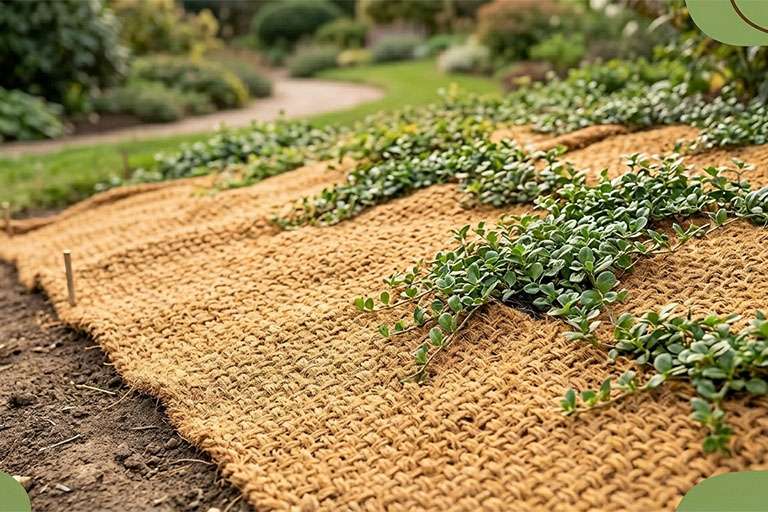

Coir Blankets: 5 Reasons Commercial Farms Are Switching from Synthetic Erosion Fabrics
5 Reasons Coir Blankets Are Replacing Synthetic Erosion Fabrics on Commercial Farms
Erosion control is one of those things that rarely gets talked about until something goes wrong. A heavy rainfall event strips the topsoil from a newly planted bed. Runoff from a sloped greenhouse floor carries growing media into the drainage channels. A freshly established outdoor berry block loses its carefully prepared soil surface in a single wet week. When that happens, you realize very quickly that what you had protecting the ground wasn’t working well enough.
Coir blankets have been used in civil engineering and land restoration for decades, but their adoption in commercial horticulture and agriculture has accelerated substantially over the past five to seven years. Growers in the Netherlands, South Korea, Canada, and the USA who have made the switch from synthetic erosion fabrics often say the same thing: they expected comparable performance and got something that actually worked better in several key ways.
Here’s what seven growing seasons of real-world feedback actually shows.
What Coir Blankets Are and How They Work
A coir blanket is a mat or roll made from coconut coir fiber, either woven into a structured geotextile format or needled into a non-woven felt-like sheet. The fiber used is typically long-strand bristle coir, chosen for its tensile strength and decomposition resistance.
The mechanism is straightforward. Laid over a soil surface, the blanket physically intercepts rainfall and irrigation water before it contacts the bare soil below. This breaks the kinetic energy of water droplets, which is the primary driver of surface erosion. The mat then slows lateral water movement across the surface, giving water time to infiltrate rather than run off.
As vegetation establishes through and around the blanket, roots grow into and through the coir matrix, creating a combined root-fiber reinforcement layer at the soil surface. At that point, the biological erosion protection takes over from the physical, and the coir blanket can begin to biodegrade without the soil surface being at risk.
According to the International Coconut Community (ICC), coir geotextile products meet international standards for biodegradable erosion control, with documented performance data across a wide range of slope gradients and rainfall intensities.
-
Biodegradation That Solves the Disposal Problem
Let’s start here because it’s the most practically significant advantage for commercial operations. Synthetic polypropylene erosion fabrics work reasonably well while they’re in place. The problem comes at end of life.
Removing a season’s worth of synthetic erosion fabric from a large field or greenhouse area is labor-intensive and expensive. The material is typically contaminated with soil, roots, and plant debris, which makes recycling impractical in most cases. It ends up in landfill. In markets like the Netherlands, Germany, and several Canadian provinces where agricultural plastic waste regulations are tightening, this is becoming a compliance issue as well as a cost issue.
Coir blankets biodegrade in place. Depending on the product grade and environmental conditions, they typically break down over two to five years, roughly timed to the establishment of permanent vegetation that takes over the erosion control function. There’s nothing to remove, nothing to dispose of, and the degrading fiber adds organic matter to the soil surface as it breaks down.
For operations using Coir Geo Textiles in ongoing production settings, this means the input budget for erosion control doesn’t need to account for removal and disposal labor, which is a real saving at scale.
-
Vegetation Establishment Through the Blanket
Synthetic erosion fabrics create a physical barrier that plants sometimes struggle to penetrate, particularly fine-rooted cover crops and grasses commonly used for between-row erosion control in orchards and berry operations.
Coir blankets, because of their fibrous open structure, allow root penetration readily. Seeds germinate through the surface and roots grow down through the mat without the resistance that synthetic fabrics can present. This makes coir blankets significantly better for applications where vegetation establishment through the blanket is part of the design.
Berry growers in South Korea and Canada using coir blankets between strawberry rows have found that cover crop establishment in blanketed areas is faster and more complete than in areas using synthetic fabric. The faster the cover establishes, the sooner the biological component of erosion control becomes the dominant protection mechanism.
-
Moisture Retention That Supports Crop Establishment
Here’s something synthetic erosion fabrics don’t do: retain moisture at the soil surface. Coir fiber holds water within its structure, creating a humid microclimate at the soil-blanket interface that supports seed germination and early root development in newly planted areas.
For commercial field operations in Mexico and Russia where newly established crop blocks are particularly vulnerable during dry periods immediately after planting, this moisture retention effect is a genuine agronomic benefit beyond erosion control. The blanket acts as a mulch as well as a protective mat, reducing evaporation from the soil surface and extending the time window before irrigation is needed.
One field manager working with a tomato operation in Mexico noted: “We started using coir blankets on our establishment rows two seasons ago, partly because we were trying to reduce plastic inputs. What we didn’t expect was how much better germination rates were in the blanketed areas compared to our control rows. The moisture retention made a measurable difference in dry spells.”
-
Temperature Moderation at the Soil Surface
The fibrous structure of coir blankets creates an insulating layer between the soil surface and the ambient environment. This moderates soil temperature in both directions, limiting peak temperatures during summer heat events and slowing heat loss during cooler overnight periods.
For berry and capsicum growers in South Korea and Japan managing crops that are sensitive to soil temperature extremes during establishment, this thermal buffering is a practical advantage. Strawberry runners in particular establish more reliably when root zone temperatures are stable, and coir blankets provide that stability passively without any additional system or input.
The insulation effect also reduces the freeze-thaw cycling at the soil surface during winter in Canadian and Russian production environments. Repeated freeze-thaw events can displace shallow-rooted crops and disrupt soil structure. A coir blanket layer reduces the frequency and intensity of these cycles at the critical surface zone.
-
Compatibility with Organic and Sustainability Certification
For growers operating under organic certification or working toward sustainability credentials required by export markets and retail buyers, the input profile of coir blankets is straightforwardly clean. Natural fiber, no synthetic additives in standard processing, fully biodegradable, and derived from an agricultural byproduct with well-documented supply chain traceability.
According to Sri Lanka Business, Sri Lankan coir products destined for certified organic operations are produced under documented processing standards, with export certification available for buyers requiring supply chain verification. This matters for operations in the Netherlands, Canada, and the USA where certification bodies require documentation of inputs used in certified areas.
Coir blankets are accepted under USDA NOP and EU organic regulations as a natural fiber input. Verify with your specific certifier if your operation uses coir blankets in areas subject to certification inspection, as documentation requirements vary by scheme.
Coir Blanket Selection Guide
Not all coir blankets perform equally, and the right product depends on your specific application. Here’s a simplified guide to the main product types.
| Product Type | Structure | Degradation Rate | Best Applications |
| Open weave coir net | Woven, open mesh | 3 to 5 years | Steep slopes, heavy rainfall areas |
| Needled coir felt | Non-woven, dense | 2 to 3 years | General soil stabilization, flat to moderate slope |
| Coir straw blanket | Mixed fiber mat | 1 to 2 years | Temporary establishment protection |
| Heavy geotextile mat | Dense woven | 4 to 6 years | High-traffic or high-flow areas |
For most commercial horticultural applications including berry blocks, greenhouse floor stabilization, and field crop establishment, needled coir felt or open weave coir net in the two to four year degradation range is the appropriate choice.
Practical Application Tips for Commercial Settings
Correct installation makes a significant difference to coir blanket performance. A few points that experienced installers and growers consistently emphasize:
Anchor the blanket firmly at the upslope edge before rolling it out. A loose upslope edge will lift under water flow and allow runoff to undercut the blanket, defeating its purpose entirely.
Overlap adjacent blanket rolls by at least 15cm and secure at the overlap. Gaps between rolls create channeling points where erosion concentrates.
Stake at regular intervals across the blanket surface, not just at the edges. In high-rainfall or high-irrigation environments, interior uplift from flowing water beneath the blanket can dislodge insufficiently staked sections.
For growing applications where the blanket will be in place for multiple seasons, choose a product grade rated for the full expected duration. Using a one-season product and expecting two-season performance is a common purchasing error.
Pairing Coir Blankets with Substrate Systems
Growers managing both erosion control and substrate inputs often find that aligning their coir-based inputs from the same supply source simplifies procurement, quality control, and certification documentation. Operations using Coco Peat Grow Bags for container production alongside coir blankets for erosion control in surrounding areas find this pairing works well both practically and from a sustainability reporting perspective.
The materials share a supply chain origin and compatible certification credentials, which reduces the documentation burden for operations managing multiple certified inputs simultaneously.
FAQs
Q: How long do coir blankets last before they decompose?
Degradation time depends on the product grade, climate, and conditions. Standard agricultural coir blankets typically last two to four years. Heavy-grade geotextile coir mats in drier conditions can last five years or more. In tropical, high-rainfall environments, degradation is faster. Products are rated by manufacturers for approximate degradation duration, and matching the product grade to the expected application timeframe is important.
Q: Can coir blankets be used in greenhouse environments?
Yes, though the application is different from field use. In greenhouses, coir blankets are used primarily for growing floor stabilization, raised bed edging protection, and pathway management rather than rainfall erosion control. The lower moisture exposure in greenhouse settings typically extends blanket longevity compared to outdoor use.
Q: Do coir blankets need to be removed before the next growing season?
No. This is one of the key advantages of coir over synthetic erosion fabrics. If the blanket is still structurally intact and providing useful function, it can remain in place. If it has degraded significantly, it can be incorporated into the soil or left to continue breaking down on the surface. No removal or disposal is needed.
Q: Are coir blankets effective on steep slopes?
Open weave coir net products designed for slope stabilization are effective on gradients up to approximately 1:1 (45 degrees) in typical rainfall conditions. For steeper slopes or areas subject to concentrated water flow, heavier-grade woven coir geotextile products combined with additional anchoring are needed. A specialist in erosion control should specify product selection for steep slope applications.
Q: What is the difference between a coir blanket and a coir geotextile?
The terms are sometimes used interchangeably, but technically coir blankets refer to lighter-weight, non-woven or lightly woven products used for temporary erosion control and vegetation establishment support. Coir geotextiles are heavier, more structured woven products designed for longer-term soil reinforcement and stabilization applications. The choice between them depends on the slope gradient, rainfall intensity, and required service life.
