


 +94 (0) 31 228 1114
  info@cocopeatcoirmulch.com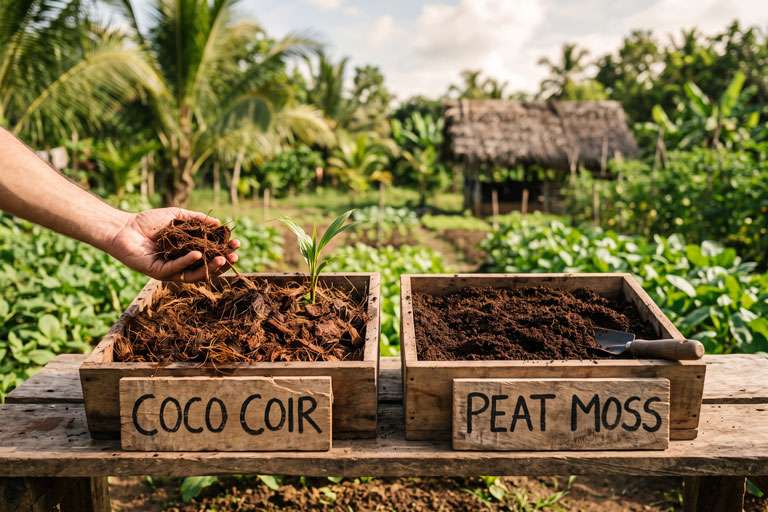

Coco Coir vs Peat Moss: 7 Differences Growers Should Know
Coco Coir vs Peat Moss: 7 Differences That Actually Change How Your Crop Performs
Ask ten greenhouse growers what they use as their base substrate, and you’ll probably get ten different answers, some loyal to the old ways, some chasing whatever the neighboring farm switched to last season. But bring up coco coir vs peat moss in that same conversation, and things get more heated than you’d expect from a discussion about growing media. Both have loyal followings. Both have decades of research behind them. And both quietly decide how well your tomatoes, peppers, cucumbers, melons, or berries perform from the day you transplant to the last pick of the season. So let’s settle this the honest way, by looking at how each one actually behaves in a working greenhouse, not just on a spec sheet.
What Exactly Are We Comparing Here?
Peat moss forms when sphagnum moss breaks down in waterlogged bogs, a process that takes centuries rather than seasons. Coco coir, on the other hand, is a by product of the coconut industry, made from the fibrous husk left over once the coconut has already been harvested for food, oil, or water. One takes geological time to form. The other takes roughly as long as it takes to husk a coconut and process the fiber. That timeline gap alone explains a good chunk of everything that follows, from how the two media handle water to how growers in different regions feel about using them.
Structurally, they’re built differently too. Peat moss particles are fine, sponge-like, and tend to compact over a growing cycle. Coco coir, once you get past the marketing photos, is actually a blend of coir pith (the fine, spongy part) and coir fiber (the coarser strands), and the ratio of the two determines how a bag drains, breathes, and holds together season after season.
Coco Coir vs Peat Moss: How They Actually Perform in the Root Zone
Here’s the part that actually matters for your yield sheet. Peat moss, once fully dried out, can become hydrophobic, meaning water beads and runs off the surface instead of soaking in evenly. If you’ve ever watered a dry peat-based bag and watched half the water pool at the edges, you already know what I mean. Coco coir doesn’t have that problem in the same way; it re-wets far more evenly, which matters a great deal in high-frequency fertigation systems running tomato, pepper, or cucumber crops on a tight irrigation schedule.
Root development also tells a story here. Cucumber and melon growers, in particular, tend to notice faster early rooting in coir compared to peat, largely because coir’s fiber content keeps the media from packing down tight around young roots. Leafy greens, which have a shallower and more delicate root system, also seem to appreciate the lighter structure. None of this means peat is a bad medium, it isn’t, but the two clearly don’t behave the same way once water and roots are involved.
Water Retention in Growing Media: A Side-by-Side Look
On paper, peat moss can hold slightly more total water by weight. In practice, though, water retention in growing media isn’t only about how much water a bag can hold, it’s about how easily that water is released back to the roots. Coco coir tends to hold a bit less total water but releases it more readily, which is why so many hydroponic and semi-hydroponic setups have gravitated toward it over the last fifteen years or so.
For berry growers running drip lines on a tight schedule, this difference shows up as fewer surprises. Less risk of a soggy root zone after a heavy irrigation cycle, less risk of that same root zone drying into a brick by the next morning if a pump hiccups. It’s not that peat can’t be managed well, plenty of growers do it beautifully, it just asks for a slightly more forgiving irrigation controller and a grower who’s paying close attention.
pH Balance in Soilless Media: Why the Difference Matters More Than Growers Think
Peat moss is naturally acidic, usually somewhere between pH 3.5 and 4.5, which means most vegetable crops need lime added before the media is even usable. Coco coir sits much closer to neutral, typically in the 5.5 to 6.8 range, which lines up nicely with what tomatoes, bell peppers, cucumbers, and most leafy greens actually prefer.
That said, coco coir isn’t a blank slate either. It naturally carries some potassium and sodium left over from processing, so growers should always ask their supplier for a water-extract analysis sheet before starting a first crop cycle. A quick look at that sheet, and a couple of EC readings during the first two weeks, will tell you almost everything you need to know about how a batch will behave with your specific nutrient program.
The Sustainability Question Growers From Europe to Canada Keep Raising
This is where the conversation stops being purely agronomic and starts touching policy. The Netherlands and several other European growing regions have already moved toward restricting peat use in horticultural media, partly over concerns about wetland carbon release and slow bog recovery. Canada, interestingly, is one of the world’s largest peat producers, yet even there, extraction is capped by how quickly bogs regenerate, which is measured in decades rather than growing seasons. A wet extraction season can genuinely tighten supply the following year, something Canadian growers have watched happen more than once in the past several years.
According to the International Coconut Community (ICC), which tracks coconut byproduct trade across major producing nations, coir pith is considered one of the more renewable alternatives to peat-based media, mainly because it’s generated continuously alongside the existing global coconut industry rather than requiring dedicated land extraction of its own. That doesn’t make coir automatically greener in every scenario, freight distance matters too, but it does explain why so many growers list sustainable growing media as a top factor when they’re deciding what to run next season.
Cost, Availability and What’s Actually Behind the Price Tag
Coco coir usually needs to travel further, since most of it comes from tropical coconut-producing regions and heads out to greenhouses in North America, Europe, the Middle East, and East Asia. That said, a compressed 25kg coco peat bale expands to several times its shipped volume once rehydrated on site, which is part of why the freight math tends to work out better than growers expect the first time they run the numbers.
Peat moss, meanwhile, is often cheaper on a per-bag basis in regions where it’s harvested locally, but that price advantage isn’t guaranteed everywhere, and it can shift quickly if extraction seasons underperform. There’s no universal winner here, honestly, it comes down to your region, your freight lanes, and how much you value price stability over the raw sticker price.
A Peat Moss Alternative That’s Actually Renewable
If you’re specifically looking for a peat moss alternative because of a supply concern, a sustainability mandate from a buyer, or just curiosity about doing things differently, coco coir checks most of the boxes growers care about: workable pH out of the bag, decent structure, and a supply chain that isn’t tied to a single region’s weather. It won’t behave identically to peat in every setup, and growers switching over should expect a short adjustment period while they recalibrate irrigation timing.
What Growers Are Actually Saying
One customer running a mid-sized pepper and cucumber operation in the Netherlands told our team, “We switched half our rows to coco coir two seasons ago just to compare results side by side. Honestly, the uniformity was the biggest surprise. Every bag behaved the same way, which made our fertigation schedule so much easier to plan around.” Our customers are really happy with our coco peat grow bags, and feedback like this is a big part of why we keep refining our processing standards batch after batch instead of treating it as a finished product.
Making the Switch Without the Guesswork
For growers seriously considering coir grow bags for commercial farming, the transition goes smoother with a few simple habits. Ask for the media’s water-extract analysis before the first fill. Expect to irrigate slightly more often than you did on peat, since coir drains faster. Check EC weekly for the first month rather than assuming your old nutrient schedule will carry over unchanged. And if you’re growing something sensitive like melons or leafy greens, run a small trial block first rather than converting the entire range in one go.
So, Which One Should You Actually Choose?
There isn’t a single correct answer here, and anyone who tells you otherwise is probably selling one or the other. Peat moss remains a solid, well-understood medium with a long track record. Coco peat for greenhouse production has earned its growing popularity by offering a more workable starting pH, gentler re-wetting behavior, and a supply chain that isn’t tied to a single region’s peat bogs. If your buyers are asking about sustainability credentials, if your region is watching peat supply tighten, or if you simply want a medium that plays nicer with modern fertigation systems, it’s worth running a side-by-side trial on your own crop before committing the whole greenhouse.
Frequently Asked Questions
Is coco coir better than peat moss for tomatoes?
Neither is objectively better across the board. Coco coir tends to suit high-frequency fertigation systems well because it drains quickly and starts near neutral pH, while peat moss offers strong, well-documented water retention if it’s managed with a consistent irrigation routine. Many commercial tomato growers now use coco coir specifically because it re-wets more evenly after a dry spell.
Does coco coir need lime like peat moss does?
Usually not. Peat moss is naturally acidic and typically needs lime added to reach a workable pH for vegetable crops. Coco coir starts much closer to neutral, so most growers skip the lime step entirely, though it’s still worth checking a fresh batch’s water-extract report before planting.
How long does a compressed coco peat bale last once rehydrated?
A properly stored compressed bale can sit unopened for a long time before use, since it’s dehydrated for shipping rather than perishable. Once rehydrated and filled into grow bags, it behaves like any fresh substrate and is typically used for one full crop cycle, though some growers reuse it for a second cycle in less demanding crops after checking its structure and salt levels.
Can coco coir and peat moss be mixed together?
Yes, and plenty of growers do exactly this to combine peat’s water-holding characteristics with coir’s drainage and structure. A common approach is a minority blend of coir mixed into a peat-based mix, though the right ratio depends heavily on the crop and your irrigation setup.
Is coco coir more sustainable than peat moss?
It’s generally considered a renewable alternative because it’s produced continuously as a byproduct of the coconut industry rather than through dedicated bog extraction, which regenerates far more slowly. That said, freight distance and processing methods also factor into the full sustainability picture, so the honest answer depends partly on where you’re growing and where your media is coming from.
