



 +94 (0) 31 228 1114
  info@cocopeatcoirmulch.com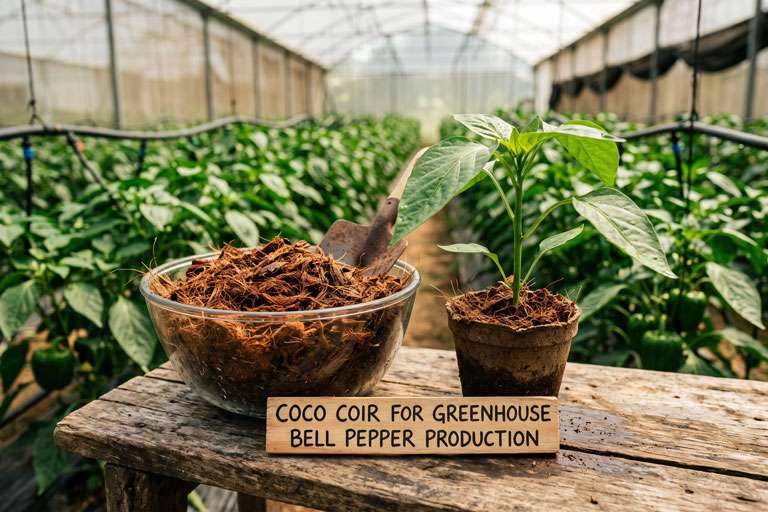

Coco Coir for Greenhouse Bell Pepper Production: 8 Grower Benefits
Coco Coir for Greenhouse Bell Pepper Production: 8 Ways It Improves Fruit Quality and Yield
Bell peppers have a reputation for being a bit dramatic in the greenhouse. Overwater them and the roots sulk. Let the media dry out even slightly during fruit set and blossom end rot shows up like clockwork a few days later. That sensitivity is exactly why so many commercial growers have shifted toward coco coir for greenhouse bell pepper production over the last decade, and once you understand what’s actually happening at the root zone, the shift makes a lot of sense.
Why Bell Peppers Are Pickier Than Tomatoes About Their Media
Pepper roots are shallower and more sensitive to waterlogging than tomato roots, which tend to be deeper and noticeably more forgiving of the odd irrigation mistake. This is part of why growers running large export blocks, whether that’s a Leamington-style greenhouse cluster, an operation in Almeria, or a shade house in Mexico, spend so much time thinking about bell pepper growing media specifically rather than treating every crop as interchangeable.
Drainage for Bell Pepper Roots: The Single Biggest Factor
If there’s one thing to get right before anything else, it’s drainage. Drainage for bell pepper roots needs to sit in a fairly narrow air-filled porosity range, usually somewhere around 25 to 35 percent, to keep roots supplied with oxygen without letting the media dry out too fast between irrigations. Coco coir’s tunable fiber-to-pith ratio makes it easier to hit that range consistently than some alternatives, and blending in husk chips can push drainage even further for growers running warmer climates or heavier fertigation programs.
Coco Coir for Greenhouse Bell Pepper Production: What Changes at the Root Zone
Peppers are heavy potassium feeders, particularly once fruit development ramps up, and this is where coir’s natural cation exchange capacity earns its keep. It helps hold nutrients available near the root zone between fertigation events, which makes the crop somewhat more forgiving if an irrigation cycle runs a little late or a pump hiccups mid-shift, something that happens in every greenhouse eventually, no matter how well the system is maintained.
EC Control and Fruit Quality: Why Consistency Beats Perfection
Uneven EC in the root zone is one of the fastest ways to end up with blossom end rot and inconsistent fruit sizing across a pepper block, both of which hurt at the grading table. Coco coir’s natural cation exchange capacity helps smooth out short-term swings in nutrient concentration between fertigation cycles, which matters more for peppers than most other greenhouse crops given how visibly they react to root zone stress. Growers running commercial pepper cultivation at any real scale tend to treat EC monitoring as a daily habit rather than a weekly check-in, and that discipline shows up directly in grading rates.
Capsicum Growing in Coco Coir: Notes for Sweet Pepper and Chili Varieties Too
It’s worth widening the lens slightly here, since capsicum growing in coco coir isn’t limited to classic bell peppers. Plenty of export greenhouse operations run sweet pepper and chili varieties alongside their bell pepper blocks in the same structure, and the same substrate principles largely carry over. Hotter chili varieties tend to tolerate a slightly higher salinity than bell peppers do, so nutrient programs usually need a modest adjustment rather than a complete rework when a grower is running mixed capsicum ranges.
Coco Coir Grow Bags for Peppers: Sizing and Setup That Actually Works
Because pepper roots are shallower than tomato roots, coco coir grow bags for peppers are typically sized a bit smaller in volume, with plant density and drip stake placement adjusted accordingly. Growers running mixed blocks often order tomato grow bags alongside pepper-specific bags just to keep supplier logistics simple, since both share a similar base coir specification with a different fiber-to-pith ratio tuned to each crop.
For growers just starting to transition a range, our standard coco peat grow bags work as a sensible starting point before moving to a more specialized pepper-specific blend once the operation has a season of data behind it.
Climate Adjustments Growers Make Across Different Regions
Pepper greenhouses look very different depending on where in the world you’re standing, and the substrate program usually shifts along with the climate. Growers in South Korea and Japan often run tighter, more controlled greenhouse environments with supplemental heating through cooler months, which slows drying and allows for slightly less frequent irrigation cycles than a grower would use in a hotter, drier setup.
In parts of Mexico and the warmer greenhouse regions of the Middle East, including operations around Dubai, the opposite problem shows up. Higher ambient temperatures pull moisture out of coco coir grow bags for peppers faster, so irrigation frequency often needs to increase during peak summer months just to keep the root zone from swinging too dry between feeds. None of this changes the core substrate chemistry, but it’s a good reminder that a feeding schedule copied from a grower in a different climate zone rarely transfers over without some adjustment.
Humidity plays its own role too. Coastal greenhouse regions with higher ambient humidity see slower evaporation from the media surface, which can mask early signs of an irrigation problem until it’s more advanced. Growers moving into a new climate zone for the first time, whether that’s a Sri Lankan supplier’s export market shifting or a grower relocating operations, tend to benefit from a short recalibration period rather than assuming last season’s settings will carry over unchanged.
Building a Season-Long Monitoring Habit
None of the drainage or EC advantages described earlier matter much if nobody’s tracking them consistently. Growers who get the most out of coco coir for pepper production tend to keep a simple log, EC and pH readings from both the feed and the runoff, checked at roughly the same time each day, alongside notes on fruit set and any blossom end rot observed that week. Patterns that would otherwise take a full season to notice show up within a couple of weeks once that habit is in place.
It doesn’t need to be complicated. A shared spreadsheet, checked by whoever is on irrigation duty that day, is usually enough to catch a slow drift in EC before it turns into a grading problem three weeks later. The growers who skip this step aren’t doing anything wrong exactly, they’re just leaving useful information on the table.
What Pepper Growers Are Saying
A commercial pepper grower supplying supermarket chains across Western Canada told us, “I used coco coir like this for my first full pepper season, ran half the range on our old media and half on coir just to compare. The coir blocks finished noticeably more evenly, with less culling at grading.” Our customers are really happy with our coco coir grow bags for exactly this reason. Fruit uniformity is what pays the bills in retail pepper contracts, and it’s usually the first thing buyers notice.
Sourcing Matters More Than Most Growers Assume
Sri Lanka’s coir processing industry has decades of export experience, and Ceylon coconut husk fiber has built a reputation for consistent particle structure over that time. That consistency matters a lot once you’re trying to standardize root zone conditions across an entire greenhouse block rather than a single test row, since a supplier with inconsistent batches can undo even a well-designed irrigation program.
Common Mistakes Growers Make Switching Pepper Blocks to Coco Coir
The most common misstep is over-irrigating out of old habits carried over from rockwool systems, since coir simply doesn’t need the same watering frequency in every setup. A close second is ordering the wrong grade of coir, using a tomato-grade blend where a finer, pepper-specific mix would perform better. And a third, easy to overlook, is failing to adjust the potassium ratio in a nutrient program to account for coir’s natural cation exchange capacity, which can leave a crop mildly under-fed even when the feed chart looks correct on paper.
Is It Worth Switching Your Pepper Range?
For most commercial operations growing bell peppers, sweet peppers, or chilies at scale, the answer leans toward yes, provided the switch is planned rather than rushed. Better drainage, a friendlier starting pH, and steadier nutrient availability all add up to fewer grading losses over a full season, and that’s the kind of improvement that shows up on the balance sheet rather than just in a grower’s notes.
The growers who get the smoothest results tend to treat the first cycle as a learning season rather than a final verdict. Keep the old media running on one or two rows for comparison, track grading numbers separately for both, and let a full harvest cycle finish before deciding whether the switch was worth it. Peppers are unforgiving of shortcuts, but they’re just as quick to reward a grower who pays attention, and that pattern tends to repeat itself season after season once the habit sticks.
Frequently Asked Questions
Is coco coir good for greenhouse bell peppers?
Yes, it’s widely used in commercial pepper production because it drains well, starts at a workable pH, and helps hold nutrients available near the root zone between irrigations, which suits a crop that reacts quickly to root zone stress.
What size coco coir grow bag works best for bell peppers?
Pepper grow bags are typically sized somewhat smaller than tomato bags because pepper roots are shallower. The exact volume depends on plant density and irrigation setup, so it’s worth confirming sizing with your supplier based on your specific spacing plan.
How often should bell peppers in coco coir be irrigated?
There’s no single fixed schedule since it depends on climate, bag size, and growth stage, but because coir drains faster than soil, most growers run more frequent, shorter irrigations than they would with a heavier medium, adjusting based on runoff readings.
Can coco coir cause blossom end rot in peppers?
The medium itself doesn’t cause blossom end rot directly, but inconsistent moisture and calcium uptake, often linked to uneven irrigation or EC swings, are common triggers. Coir’s structure tends to reduce those swings compared to some alternatives, which is part of why it’s popular for pepper crops.
Is coco coir suitable for both bell peppers and chili peppers?
Yes, the same core substrate principles apply across the capsicum family. Chili varieties generally tolerate slightly higher salinity than bell peppers, so nutrient programs usually need a modest adjustment rather than a different substrate altogether.
