



 +94 (0) 31 228 1114
  info@cocopeatcoirmulch.com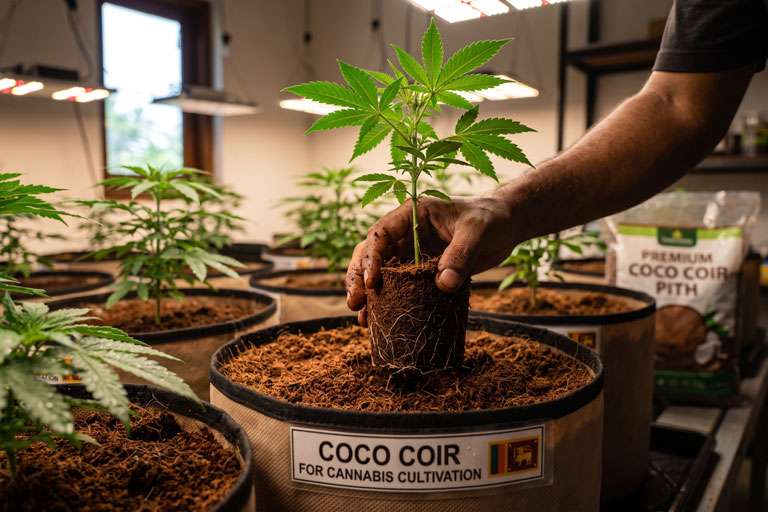

Coco Coir for Cannabis Cultivation: 6 Grower Essentials
Coco Coir for Cannabis Cultivation: 6 Things Commercial Growers Need to Get Right
Legal cannabis cultivation has grown into a genuine agricultural sector, and growers who once treated substrate as an afterthought are now studying it the way agronomists study soil chemistry. Spend any time inside a commercial cannabis facility and you’ll notice how often coco coir for cannabis cultivation comes up in conversation, usually somewhere between the irrigation controller and the nutrient tank. There’s a reason for that, and it isn’t just a passing trend.
Why Cannabis Growers Keep Circling Back to Coco Coir
Cannabis is a fast, hungry plant with a root system that rewards oxygen and punishes stagnant, waterlogged conditions. That combination is a big part of why cannabis growing media conversations so often land on coir. It roots quickly, it plays well with precise fertigation, and it tends to carry lower disease pressure than soil-based mixes, which matters enormously to licensed producers who need repeatable results across an entire facility rather than one lucky room.
There’s also the standardization angle, something soil growers rarely have to think about. When every plant in a flower room sits in media with the same structure and starting chemistry, variability between plants drops noticeably, and that consistency is worth real money to anyone selling into a regulated, testing-heavy market.
Coco Coir for Hydroponic Cannabis: Where It Fits in the System
Coco coir sits in an interesting middle ground. It’s not quite full hydroponics the way rockwool or deep water culture setups are, but it’s also nothing like soil. Growers often describe it as semi-hydroponic, and that description fits well when you look at how it behaves: enough water holding to carry a plant through a short gap between irrigations, enough air-filled porosity to keep roots breathing between cycles.
That in-between quality is also why so many facilities transitioning off rockwool land on coir rather than jumping straight to soil. Rockwool is fantastic for uniformity, but disposal is a genuine headache in jurisdictions with strict waste rules, and it doesn’t compost. Coir sidesteps that problem entirely, since spent material can often be repurposed for outdoor beds or composted where local regulations allow, which matters more each year as licensed producers face growing pressure to document their waste streams.
That balance is exactly why so many commercial cannabis rooms have moved toward open top planter bags filled with coir instead of traditional soil pots. They combine root visibility for quick health checks with the kind of consistent drainage that soil at scale rarely delivers, and they slot neatly into drip irrigation and fertigation setups already common in Sea of Green and Screen of Green rooms.
EC Management in Cannabis Cultivation: The Non-Negotiable Skill
Cannabis is genuinely sensitive to salt buildup, which makes EC management in cannabis cultivation one of the first skills any grower needs to master before scaling up. Starting with a low-salt substrate matters here, so it’s worth asking a supplier whether the coir has been rinsed to remove excess natural salts before packing, rather than assuming every bag arrives at the same starting point.
Runoff testing during flowering is where most of the real information lives. A steady climb in runoff EC over a few days usually means the plant isn’t taking up nutrients as fast as they’re being applied, and it’s far easier to catch that early than to untangle a lockout issue two weeks into flower when bud development is already underway.
Root Zone Oxygen for Cannabis: Why Structure Beats Everything Else
Cannabis roots need oxygen, especially once flowering kicks in and the plant’s demand for water and nutrients climbs sharply. This is where root zone oxygen for cannabis becomes less of an abstract concept and more of a daily concern. Fine, dust-heavy coir compacts over time and can suffocate roots in a busy flower room, so most commercial growers lean toward coarser coir and husk chip blends specifically for cannabis rather than the finer grade used for delicate seedlings.
Coir, the fiber extracted from coconut husks, is naturally high in lignin, which is part of why it resists breaking down mid-cycle compared to some organic soil amendments. That durability matters a lot once you’re running back-to-back harvests through the same growing structure without replacing media between every single cycle.
Coco Coir Feeding Schedule: Getting Fertigation Frequency Right
Because coir drains faster than soil, a workable coco coir feeding schedule for commercial cannabis usually means more frequent, smaller irrigations rather than fewer large ones, sometimes six to eight small feeds a day during peak flower, depending on pot size and canopy demand. That’s a real shift for anyone coming from a single daily hand-watering habit, and it’s worth building the irrigation program gradually rather than flipping the whole facility over on day one.
Climate matters here too. Rooms running higher VPD and stronger airflow will pull moisture out of coir faster than a humid, still room will, so feeding frequency should track your environmental setpoints, not just a generic chart pulled from somewhere online.
It’s also worth pointing out that pot size changes the math considerably. Smaller containers, common in high-density Sea of Green layouts, dry out faster and often need more frequent, smaller feeds than the larger containers used in Screen of Green setups with fewer, bigger plants. Growers moving between the two styles within the same facility sometimes forget to adjust their irrigation program accordingly, and that mismatch shows up as uneven canopy development long before it shows up anywhere else.
Pairing Coco Coir With Automated Fertigation in Commercial Rooms
Most commercial cannabis facilities now run some form of automated fertigation, and coir happens to pair well with that kind of setup precisely because its drainage behavior is so consistent from bag to bag. Dosing systems calibrated for one batch of media tend to keep performing predictably on the next, which isn’t always true with soil blends that vary more from supplier to supplier.
That predictability becomes especially valuable once a facility scales past a single room. Managing fertigation across ten flower rooms with ten slightly different substrates is a logistical mess. Standardizing on one coir specification across the whole site, even if that means working closely with a supplier on custom particle size and salt targets, tends to pay for itself once a facility passes a certain size, simply because it removes one more variable that a grow team has to babysit every day.
Common Mistakes When Switching a Cannabis Room to Coco Coir
The most frequent misstep is carrying over an old irrigation schedule from soil or rockwool without adjusting it, which usually leads to either overwatering early on or underfeeding once the plant hits its stretch phase. A close second is skipping runoff testing altogether and only checking input EC, which misses the whole point of monitoring a living root zone rather than just the feed going in.
A third mistake, easy to overlook in a busy facility, is ignoring particle size when reordering media. A batch that’s noticeably finer or coarser than the last one can quietly shift irrigation needs across an entire room, and a grow team that doesn’t know to expect that change can spend days chasing a problem that’s really just a substrate variation.
What Licensed Producers Are Saying
A licensed producer running a mid-scale flower operation in Ontario told us, “We moved three of our rooms to coco coir mainly for consistency between batches. Honestly, the biggest win wasn’t yield, it was how predictable every cycle became once we standardized on one substrate.” Our customers are really happy with our coco peat grow bags for exactly this reason. Batch after batch behaves the same way, which counts for a lot when you’re operating under strict compliance and reporting requirements.
Commercial Cannabis Substrate: What to Ask Your Supplier Before You Commit
Before ordering at scale, it’s worth pushing your supplier for specifics rather than accepting a vague product description. Ask for a chemical analysis sheet for the current batch, ask about the fiber-to-pith ratio and particle size distribution, and ask whether packaging is compressed or loose fill, since that affects freight cost and on-site storage space. Consistency across harvest lots is the whole point of moving to a commercial cannabis substrate like coir in the first place, so it’s fair to expect documentation that backs that up.
Getting Started Without Wasting a Cycle
If you’re switching an existing facility over, run a small trial room first instead of converting everything at once. Keep detailed EC and pH logs from day one, adjust irrigation frequency in small steps rather than big jumps, and give your team a full cycle to get comfortable reading the plants before judging the medium on yield alone. A rushed switch tends to blur the line between a substrate problem and an irrigation-habit problem, and those two things need very different fixes.
Frequently Asked Questions
Is coco coir good for cannabis cultivation?
Yes, it’s one of the most widely used media in commercial cannabis facilities because it drains well, roots quickly, and gives growers precise control over fertigation. It sits between soil and full hydroponics, which suits cannabis’s fast growth cycle and heavy nutrient demand during flowering.
How often should I water cannabis grown in coco coir?
It depends on pot size, plant stage, and room climate, but commercial flower rooms often run several small irrigations a day rather than one large watering, since coir drains faster than soil. Runoff EC readings are the best way to fine-tune frequency for your specific setup, since they show what’s actually happening at the root, not just what the controller is scheduled to deliver.
Does coco coir affect cannabinoid or terpene levels?
The substrate itself doesn’t directly drive cannabinoid or terpene production, that’s mostly genetics, light, and nutrient program. What coir does influence is consistency, since uniform root zone conditions across a room tend to reduce plant-to-plant variability, which indirectly supports more even quality across a harvest.
Can coco coir be reused for a second cannabis cycle?
Some growers reuse coir for a second cycle after checking its structure hasn’t broken down and testing salt levels, but most commercial operations replace it between cycles to keep starting conditions consistent and reduce disease carryover risk.
What EC level is safe for cannabis in coco coir?
Safe ranges shift by growth stage and specific nutrient line, but most growers start on the lower end during vegetative growth and increase gradually through flowering while watching runoff EC closely. There’s no single universal number, which is exactly why regular runoff testing matters more than following a fixed chart.
