


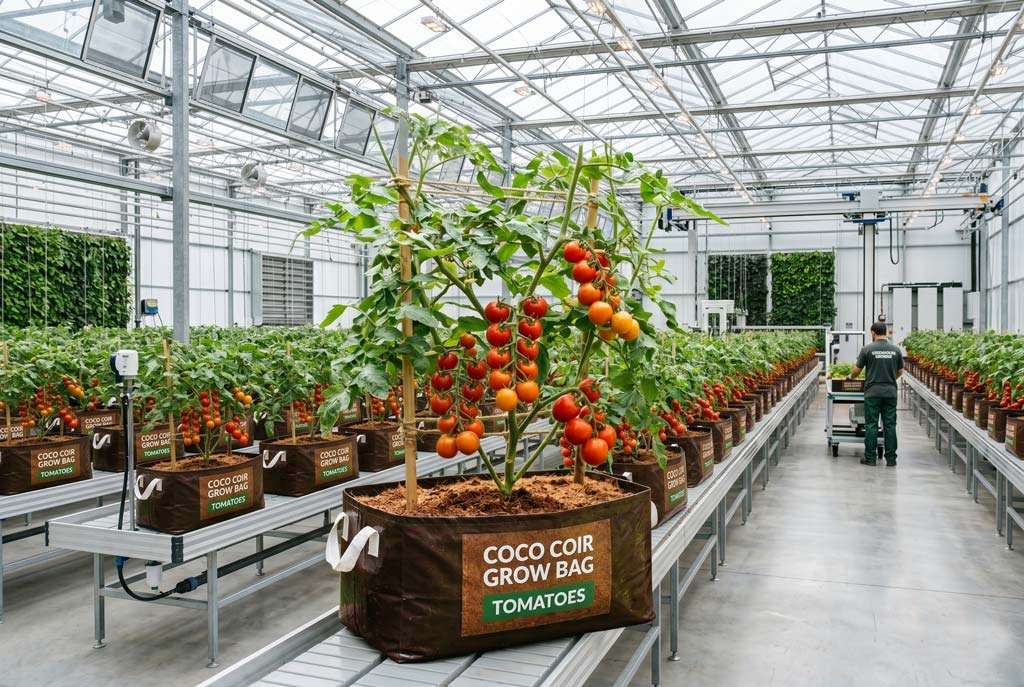
7 Reasons Coco Coir Grow Bags for Tomatoes Are Changing Greenhouse Farming
If you’ve spent any time managing a commercial greenhouse, you already know the frustration. Soil gets compacted, drainage becomes erratic, root diseases creep in, and before you know it, a whole crop cycle is compromised. That’s exactly why growers across South Korea, the Netherlands, Canada, and the USA are rethinking their substrate choices. Coco coir grow bags for tomatoes have moved from a niche option to a genuine staple in high-output greenhouse systems, and the results speak for themselves.
Here’s the thing though: not all coco coir grow bags are made equal. The processing quality, compression ratio, and fiber-to-pith balance matter enormously once you’re dealing with hundreds of linear metres of growing channels. So let’s walk through what actually makes this substrate work so well for tomato production, and why growers who’ve made the switch rarely look back.
What Makes Coco Coir Such a Natural Fit for Tomatoes?
Tomatoes are, honestly, a bit demanding. They want consistent moisture but punish waterlogging. They need strong aeration around the root zone but can’t tolerate drought stress during fruit set. Getting that balance right in a soil-based system requires constant attention. Coco coir’s naturally fibrous structure gives roots the breathing room they need while still retaining enough moisture to buffer against short irrigation gaps.
The pore structure in quality coco pith is layered: large macro-pores drain freely while fine micro-pores hold water and nutrients close to the root hair zone. For a high-demand crop like tomatoes, this is essentially what root-zone perfection looks like. You’re not fighting the substrate; you’re letting it do the work.
As noted by the International Coconut Community, coir pith is among the most renewably sourced growing media available a factor increasingly important to greenhouse operations seeking sustainable certification. For commercial tomato producers managing environmental audits, that provenance matters.
Drainage and Aeration: The Twin Advantages
Let me explain why drainage gets so much attention in tomato cultivation. Phytophthora root rot and Pythium are the two diseases most likely to devastate a tomato crop without warning. Both thrive in poorly aerated, waterlogged root zones. Coco coir grow bags are specifically structured to avoid this.
When properly hydrated, a quality coco grow bag maintains roughly 35-45% air-filled porosity even at container capacity. That’s a range where tomato roots actively colonize the full volume of the bag, rather than clustering near the top or near drainage slits. You can see this clearly when you open spent bags after a full growing season. Healthy root systems look almost woven into the coir matrix.
One of our customers a large-scale tomato grower in South Korea with over 8,000 m² under glass told us: “We switched from rock wool to coco grow bags three seasons ago and the root health scores from our plant pathologist improved dramatically. Less Pythium, better uniformity across the crop.” That kind of feedback consistently tracks with what the substrate science says.
If you’re comparing substrate options, it’s also worth looking at grow bags for tomato production specifications alongside drainage data from your current system. The side-by-side numbers tend to make the case pretty clearly.
EC and pH Stability in the Root Zone
Here’s something that catches growers off guard the first time they work with coco coir: raw coir contains naturally high potassium and sometimes elevated sodium, depending on the processing source. This can interfere with calcium and magnesium uptake if the substrate hasn’t been properly buffered.
Buffered coco coir, which is what any reputable exporter should be supplying, has had these ions displaced through a calcium-rich pre-treatment. The result is a chemically stable root environment where your drip fertigation schedule actually does what it’s supposed to do. EC management becomes far more predictable, and calcium deficiency, which is one of the most common quality issues in commercial tomatoes, becomes significantly easier to control.
For growers running recirculating nutrient systems, this stability is a major operational asset. Less pH drift means fewer correction cycles, which translates directly into labour savings per production cycle.
Coco Coir Grow Bags for Tomato Compared to Other Substrates
| Feature | Coco Coir Grow Bag | Rock Wool | Perlite |
| Water retention | High | Moderate | Low |
| Aeration | High | High | Very High |
| Sustainability | Excellent | Poor | Moderate |
| EC stability (buffered) | Excellent | Neutral | Neutral |
| Reuse potential | Yes (1-2 seasons) | Limited | Partial |
| Cost per cycle | Low-Medium | Medium-High | Medium |
How Planting Density and Bag Layout Affect Yield
This is an area where growers sometimes leave yield on the table. The physical layout of your grow bags, including spacing, orientation, and drainage slit positioning, affects how uniformly roots colonize the substrate. For indeterminate tomato varieties common in Dutch-style greenhouse production, a 100-litre equivalent per plant is a common benchmark, but this varies by variety and season length.
Wider bags allow for slightly more root volume per plant, but the key is ensuring drainage slits are cut at the correct height to maintain a consistent moisture gradient from top to bottom. If slits are too low, the bottom half of the bag stays saturated. If they’re too high, you’re losing water retention capacity you’ve paid for.
For operations considering a wider substrate portfolio, the Coco Peat Grow Bags range offers several bag dimensions and compression ratios, which is worth reviewing before finalizing your greenhouse layout.
Sustainability Credentials That Actually Matter
The coir industry is built on a by product that would otherwise be treated as agricultural waste. According to the Sri Lanka coir industry overview, Sri Lanka produces significant volumes of coir fibre and pith annually, with a substantial share destined for horticultural export. Choosing Sri Lankan-processed coco coir connects your operation to a supply chain that supports rural communities while reducing reliance on mined substrates like peat moss.
For greenhouse operations that report to buyers or retail customers with sustainability requirements, this provenance can be documented and verified. That’s increasingly a commercial necessity, not just a marketing angle.
I’ve spoken with growers in the Netherlands who specifically request country-of-origin documentation for substrate purchases as part of their MPS certification audits. Sri Lankan coir ticks that box reliably.
Frequently Asked Questions
How many times can I reuse coco coir grow bags for tomato crops?
With proper sterilization between cycles, quality coco coir grow bags can typically be used for two growing seasons. The fibre structure gradually breaks down with multiple uses, which affects air-filled porosity. After the second season, the spent coir makes excellent soil amendment or composting material.
Do coco coir grow bags need to be buffered before use?
Yes, absolutely. Unbuffered coco coir contains elevated potassium and sometimes sodium, which can create cation exchange competition with calcium and magnesium. Always confirm with your supplier that bags have been pre-buffered with calcium before delivery.
What EC level should I target when irrigating tomatoes in coco coir?
Most commercial tomato programmes target a drain EC of 3.5-5.0 mS/cm for indeterminate varieties during peak production. The incoming nutrient solution EC typically runs 2.5-3.5 mS/cm, with adjustments made based on plant growth stage and season. Your local crop advisor should validate these ranges for your specific variety and climate.
Can I use coco coir grow bags for tomatoes in an outdoor polytunnel?
Yes, though outdoor and polytunnel environments introduce more temperature variability than controlled greenhouses. Coco coir’s thermal buffering is reasonable but not as stable as a heated greenhouse. Pay attention to root zone temperature during cold nights, as tomatoes suffer significant stress below 12°C at the root zone.
Is there a difference between coco coir grow bags from different countries?
Yes, significantly. Processing standards, washing protocols, and buffering quality vary considerably by source region. Sri Lankan coir has a well-established reputation for low electrical conductivity and consistent fibre-to-pith ratios, largely because the industry has been export-oriented for decades with quality standards aligned to European greenhouse requirements.