


6 Reasons Coco Coir Grow Bags for Strawberries Are Reshaping How Berry Growers Think About Substrates
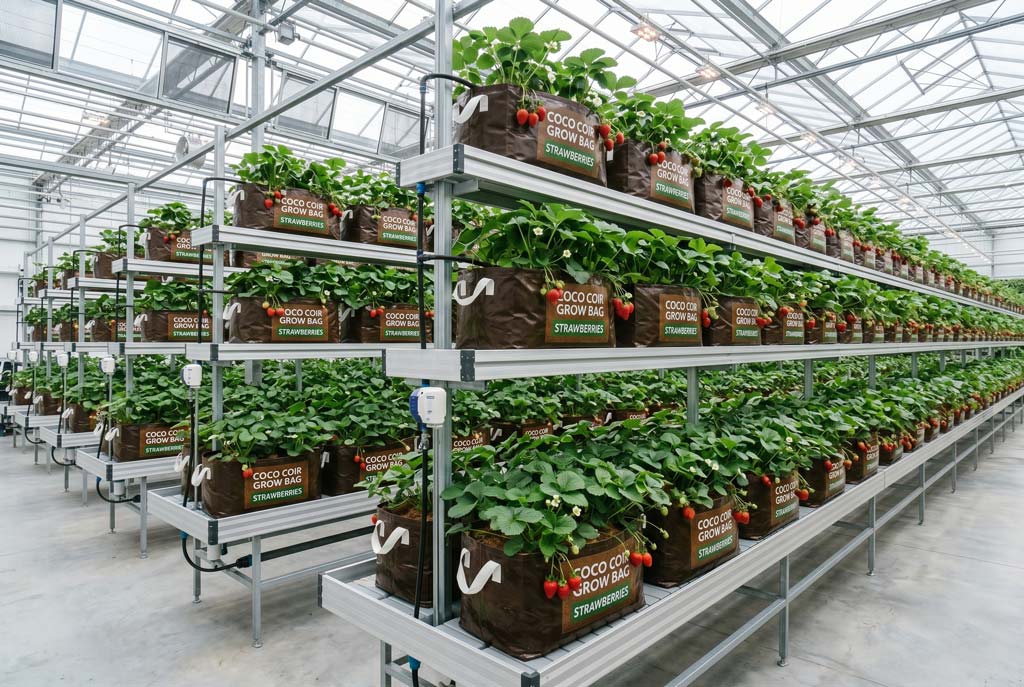
Strawberry production has quietly become one of the most sophisticated segments of commercial horticulture. Walk into a modern strawberry greenhouse in Japan or a tabletop production facility in Canada, and you’ll see precision growing systems that look more like something from a laboratory than a traditional farm. At the heart of many of these systems: coco coir grow bags for strawberries, elevated off the ground and run with drip irrigation that delivers nutrient solution in carefully timed pulses.
So why are strawberry growers, who are notoriously cautious about changing anything that’s working, making this switch? Let’s walk through what’s actually driving the shift and what the practical outcomes look like in real production environments.
Elevated Systems and Root Zone Control
One of the defining features of modern strawberry greenhouse production is the move to elevated or tabletop systems, where grow bags or troughs are raised to working height. This approach transforms labour efficiency: picking, pruning, and plant management all happen without bending. But it also changes the physics of root-zone management significantly.
When substrate is elevated and freely draining, water management becomes more critical. There’s no soil buffer beneath the bag to absorb surplus irrigation or release stored moisture during dry periods. The substrate has to carry all of that function itself. This is where coir’s balance of water retention and drainage gives it a real edge over alternatives like perlite or coarse sand, both of which drain too fast for elevated strawberry production without complex sub-irrigation systems.
Growers exploring coco coir grow bags for strawberries for the first time often start with a specific look at Grow Bags for Strawberry specifications before adapting their irrigation scheduling. Matching bag volume and density to your specific variety and climate is a good first step before committing to a full system rollout.
Strawberry Fruit Quality and Substrate Chemistry
Here’s something that doesn’t always make it into the growing media marketing materials: the chemistry of your substrate affects fruit quality, not just yield. Strawberries are sensitive to calcium availability in the root zone. Calcium deficiency drives tip burn on young leaves and can cause internal browning in developing fruit a quality issue that’s invisible until you cut open the berry at the packhouse.
Buffered coco coir provides a stable calcium environment when your fertigation programme is correctly calibrated. The pre-treatment process that removes excess potassium and sodium from raw coir creates an exchange complex that holds calcium effectively without blocking uptake. For strawberry growers selling into premium retail channels where fruit quality is inspected at the packhouse gate, this substrate stability has direct commercial value.
Our customers in the berry sector have noted this specifically. One commercial strawberry producer in southern Canada running a 4-hectare elevated tabletop system reported that tip burn incidence dropped by around 40% in the first season after switching to properly buffered Sri Lankan coco coir. They attributed this primarily to improved calcium uptake consistency rather than any change in their fertigation recipe.
Managing Root-Zone Temperature in Coir Bags
Strawberry is a cool-loving crop by temperament, even in greenhouse production. Root zone temperatures above 20°C can suppress growth and reduce fruit set. This is a real challenge in elevated systems during summer production, where bags can absorb significant radiant heat from below when positioned on dark gully surfaces.
Coco coir has reasonable thermal mass compared to more porous substrates, which means it responds more slowly to temperature changes a buffer against rapid heat accumulation during the day. White polyethylene wrapping on bags reflects incoming radiation and reduces surface temperatures significantly. Some growers in warmer climates run night-time cooling cycles through their irrigation system, using cooler groundwater to reduce root zone temperature.
According to the International Coconut Community, coir pith’s unique cellular structure contributes to its thermal buffering properties a characteristic that benefits root-sensitive crops like strawberry in ways that purely mineral substrates cannot match.
Coco Coir Grow Bags for Strawberries Across Different Production Systems
| System Type | Recommended Bag Size | Irrigation Frequency | Plants per Bag |
| Tabletop elevated | 75-100 cm x 15 cm | Short, frequent (8-12/day) | 4-6 plants |
| Gutter system | 100 cm x 18 cm | Moderate frequency | 4-5 plants |
| Ground-level rows | 100 cm x 20 cm | Standard drip cycle | 5-6 plants |
| Vertical tower | Individual pots | Sensor-driven | 1 plant each |
The Sustainability Story Behind Sri Lankan Coir
Strawberry is a crop with an interesting sustainability story of its own it’s been transitioning away from soil fumigation with chemicals like methyl bromide for decades, and substrate-based production systems are part of that shift. Using coco coir adds another layer: a substrate derived from coconut husks that would otherwise be treated as agricultural waste, processed in Sri Lanka using increasingly low-energy methods.
The Sri Lanka coir industry employs significant rural workforce in coastal regions where coconut processing has been the economic backbone for generations. When you source coir from Sri Lanka, you’re participating in a supply chain with a genuine social sustainability dimension alongside the environmental one. For berry brands selling into markets with ethical sourcing requirements, that documentation is increasingly valuable.
Looking at the broader substrate options from Sri Lanka, Coir-based Product Exporters in Sri Lanka provide a range of growing media formats that go well beyond basic grow bags including coir pith bales for blending custom substrate mixes tailored to specific berry production requirements.
Frequently Asked Questions
Are coco coir grow bags suitable for day-neutral strawberry varieties?
Yes, and in fact many commercial day-neutral programmes specifically prefer coir for the consistent moisture management it provides across variable seasons. Day-neutral varieties produce fruit continuously, which means the root zone is under sustained productive pressure for longer periods. Coir’s structural durability makes it a good match for these extended production cycles.
How do I sterilize coco coir grow bags between strawberry crops?
Steam sterilization at 70-80°C for 30 minutes is the most effective method for eliminating residual pathogens between crop cycles. Some growers use hot water flooding followed by hydrogen peroxide treatment. Chemical sterilants can work but need to be fully flushed before replanting to avoid phytotoxicity.
What pH range should I maintain for strawberries in coco coir?
Strawberries prefer a slightly acidic root zone, ideally pH 5.8-6.2. Coco coir naturally has a pH of around 5.5-6.5 depending on origin and processing, which typically puts it right in the productive range for strawberry without significant correction. Monitor drain pH regularly and adjust your nutrient solution pH as needed.
Can I use coco coir grow bags for both June-bearing and everbearing strawberry production?
Yes, both type groups work well in coco coir. The primary adjustments relate to plant density, irrigation frequency, and crop cycle length rather than substrate selection. June-bearing varieties have a concentrated fruiting period and are often managed as an annual crop in substrate systems, while everbearing varieties are typically managed over a longer production window.
How does coco coir compare to perlite for strawberry in elevated gutters?
Coir generally outperforms perlite for strawberry in elevated gutter systems because of its superior water retention between irrigation events. Perlite drains very quickly and requires a higher irrigation frequency and more precise controller timing to maintain adequate moisture. Coir provides more buffer and tends to be more forgiving during equipment downtime or irrigation scheduling errors.