


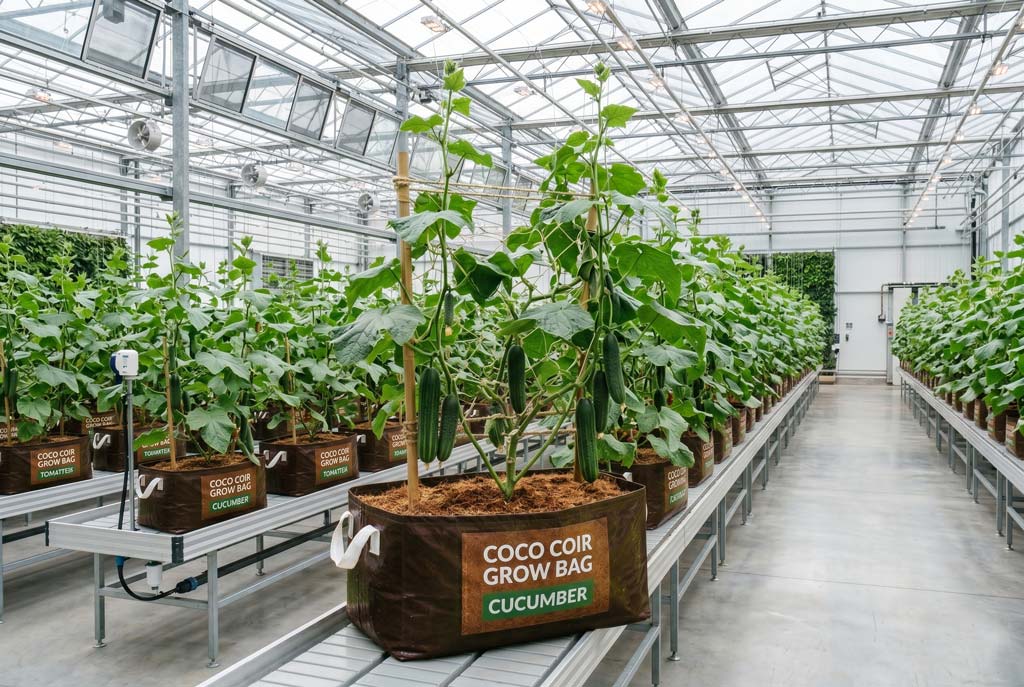
5 Growing Advantages of Coco Coir Grow Bags for Cucumber That Commercial Growers Swear By
Cucumber is one of those crops that looks simple until you’re managing thousands of plants under glass with a tight production schedule. The root system is aggressive, water demand is high, and the crop is unforgiving when root-zone conditions aren’t right. More and more commercial cucumber operations, from Japan’s precision greenhouses to Mexico’s export-focused polytunnels, are moving to coco coir grow bags for cucumber cultivation, and the agronomic logic behind this shift is solid.
You know what’s interesting? Cucumber and coir are, in a way, both products of tropical agriculture. There’s something fitting about a tropical crop performing so well in a substrate derived from tropical coconut husks. But let’s set aside the poetic angle and look at what actually matters in the root zone.
Why Cucumbers Are Particularly Suited to Coir Substrates
Cucumber roots grow fast and need space. A mature cucumber plant in a Dutch-style greenhouse can develop a root system that covers the entire volume of a standard grow bag within six to eight weeks of planting. This aggressive colonization pattern means the substrate needs to maintain its physical structure, including air pockets, drainage channels, and moisture retention capacity, throughout the whole crop cycle.
Coco coir’s fibrous structure does this remarkably well. Unlike perlite, which can stratify and create uneven moisture distribution, or rock wool, which can become compacted near drainage points, well-processed coir maintains relatively consistent porosity from top to bottom of the bag. For a crop as root-active as cucumber, this consistency translates into fewer irrigation management problems and more predictable plant response.
According to coir’s documented properties as a growing medium, the material’s natural lignin content contributes to its durability and slow decomposition rate both important for maintaining root-zone structure across a full cucumber growing season that can run six months or longer in year-round production systems.
Coco Coir Grow Bags for Cucumber: Water Management Made Simpler
Here’s the thing about cucumbers and water: they consume a lot of it, but they’re sensitive to both surplus and deficit. Overwatered cucumbers develop shallow root systems that are vulnerable to oxygen stress. Underwatered plants show wilting and can trigger bitter cucurbitacin accumulation in the fruit which is the last thing you want in a crop destined for the fresh market.
Coco coir’s water-holding behaviour sits in a sweet spot for cucumbers. The pith fraction retains moisture effectively while the fibre component maintains drainage channels even when the substrate is near saturation. Many growers use frequency-based irrigation scheduling with coir short, frequent irrigation pulses that keep the substrate moisture level within a tight band rather than the longer, less frequent cycles common with rock wool.
I used this irrigation approach with cucumber crops running a 15-minute cycle frequency during peak summer production, and the consistency in fruit diameter across the crop was notably better than what we’d seen with the previous perlite-based system. The root zone just stayed more uniform.
For operations that are also growing other crops in the same facility, the open top planter bags format works particularly well for cucumber because it allows easier root inspection and substrate monitoring without disturbing the plant.
Disease Suppression in Coir-Based Systems
One of the less-discussed benefits of coir for cucumber production is its role in suppressive growing environments. Certain Trichoderma species naturally colonize coir substrate and can provide some bioprotection against soil-borne pathogens, though this should be considered a complementary benefit rather than a replacement for a full disease management programme.
What’s more consistently documented is the physical disease suppression effect: coir’s drainage characteristics reduce the standing moisture conditions that Pythium and Phytophthora require to sporulate and spread. For cucumber, where Pythium crown rot can move through a crop with alarming speed under wet conditions, this physical barrier effect has real practical value.
Our customers running cucumber operations in the UAE and Russia have specifically noted reduced fungicide application frequency after switching substrates. Whether that’s directly attributable to the coir or to improved overall irrigation management that the switch prompted, the end result is the same: healthier crops, lower chemical costs.
Nutritional Management for Cucumbers in Coir
Cucumber is a moderate-to-high nutrient demand crop with some specific sensitivities. Magnesium deficiency is common in high-yield cucumber production, and calcium is critical for preventing tip burn and maintaining fruit quality. Both of these nutrients can be impacted by the cation exchange characteristics of the substrate.
Properly buffered coco coir has a relatively neutral cation exchange capacity after treatment, meaning it doesn’t compete significantly with your nutrient solution for calcium and magnesium. This gives growers more reliable fertigation control than they’d typically get with unbuffered substrates.
The coir product industry in Sri Lanka has invested significantly in processing technology specifically to address the historical challenge of potassium and sodium contamination in raw coir. Modern Sri Lankan-processed coir, particularly from established exporters, consistently meets the low EC and low sodium specifications required by European greenhouse standards.
Comparing Grow Bag Sizes for Cucumber Crops
| Bag Specification | Plants per Bag | Best For | Drain Slit Position |
| 100 cm x 20 cm | 2 plants | Mini-cucumber, short cycle | 2-3 cm from base |
| 120 cm x 20 cm | 2-3 plants | Standard slicer cucumber | 2-3 cm from base |
| 150 cm x 20 cm | 3 plants | Long English cucumber, high-wire | 3 cm from base |
| 100 cm x 25 cm | 2 plants | Beit Alpha / snack cucumber | 2-3 cm from base |
End-of-Season Coir Disposal and Circular Agriculture
One practical question that greenhouse managers often ask is what to do with spent coir at the end of a production cycle. Unlike rock wool, which is technically recyclable but practically difficult to dispose of, spent coco coir has genuine value as a soil amendment. High in lignin and partially decomposed organic matter, end-of-cycle coir improves soil structure and water retention when incorporated into field soils.
Some greenhouse operations near arable farmland have established informal coir exchange arrangements, supplying neighbouring farms with spent substrate in return for reduced disposal costs. It’s a genuinely circular approach that aligns with where European agricultural sustainability policy is heading.
Learn more about the coir fibre properties and uses to understand why spent coir makes such effective soil conditioning material after its life as a growing substrate is complete.
Frequently Asked Questions
How long does a coco coir grow bag last for cucumber production?
For most commercial cucumber operations running a single long crop per year, a quality coco coir grow bag will perform well for one full season. With thorough steam sterilization between cycles, some growers successfully use bags for a second season, though the substrate’s air-filled porosity does decrease with repeated use.
Do I need to pre-wet coco coir grow bags before planting cucumber?
Yes. Dry compressed coir requires thorough pre-wetting and expansion before planting. Most grow bags are supplied compressed and need to be hydrated with clean water or a low-EC fertigation solution for 24-48 hours before transplanting. This ensures full expansion and uniform moisture distribution throughout the bag.
What nutrient solution EC is recommended for cucumber in coco coir?
Commercial cucumber programmes typically target a nutrient solution EC of 2.0-3.5 mS/cm, with drain EC running 3.5-5.0 mS/cm during peak production. Early growth stages use lower EC to encourage root development. Always calibrate based on your local water quality and specific variety recommendations.
Can I grow mini cucumbers and standard slicers in the same bag format?
Technically yes, but optimizing bag size and planting density for each variety type typically gives better results. Mini cucumber and snack varieties have smaller root systems and can perform well in narrower bags, while large slicer and English cucumber varieties benefit from wider profiles that accommodate their more extensive root development.
How do I prevent algae growth on the surface of coco coir grow bags?
Algae grows where light meets moisture. The simplest prevention is covering the top of grow bags with white-on-black polyethylene mulch film, which blocks light penetration while reducing evaporative moisture loss. Most commercial grow bag systems already incorporate this approach as standard practice.