


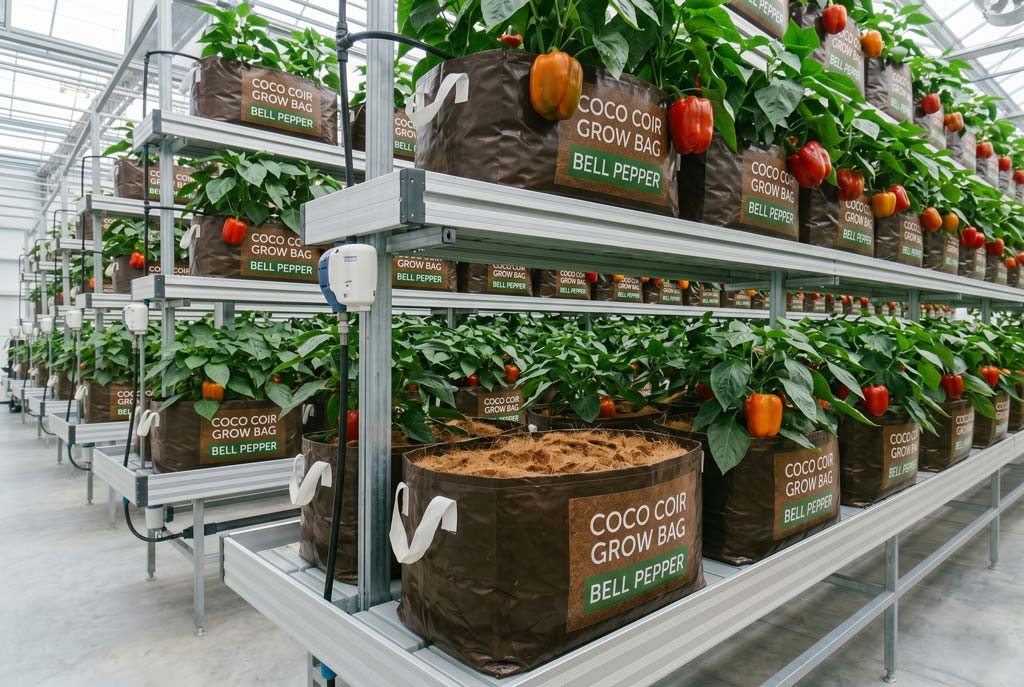
8 Key Benefits of Coco Coir Grow Bags for Bell Pepper That High-Yield Growers Are Talking About
Bell pepper, or capsicum depending on which market you’re selling into, is one of the most consistently profitable greenhouse crops in the world. It’s also one of the most demanding. Long production cycles, high calcium requirements, sensitivity to waterlogging, and a root system that can occupy a grow bag for 10-12 months create a very specific set of substrate requirements. Coco coir grow bags for bell pepper have emerged as a frontrunner across commercial greenhouse operations in the Netherlands, Russia, USA, and increasingly in Japan and South Korea.
What’s driving the adoption? Honestly, it’s a combination of things. Some growers came to coir after disease problems in other substrates. Others were pushed by sustainability procurement requirements from their retail buyers. A few just ran the numbers on substrate cost per kilogram of fruit produced and found coir hard to argue with. Let’s get into what makes it work.
Long-Cycle Performance: Where Coir Really Earns Its Reputation
Bell pepper is not a short-season crop. In Dutch-style high-wire greenhouse systems, a single bell pepper planting can stay in production for 10-12 months, meaning the grow bag substrate is under continuous root pressure for nearly a full year. This is where substrate durability matters enormously.
Rock wool handles long cycles well structurally, but its environmental footprint and disposal challenges have pushed many growers to look elsewhere. Perlite maintains structure but can’t retain enough moisture between irrigation cycles for a crop as thirsty as bell pepper in summer. Coir sits in a genuinely practical middle ground: durable enough to maintain air-filled porosity across a full season, water-retentive enough to buffer irrigation gaps, and regenerative enough that it can be sterilized for a second cycle if needed.
The Coco Peat Grow Bags range is specifically designed with density specifications optimized for long-cycle crops. This detail matters in practice because bags that are too loosely packed will settle and lose air porosity within the first two to three months.
Coco Coir Grow Bags for Bell Pepper: Calcium and Blossom End Rot Prevention
Blossom end rot in bell pepper. If you’ve grown capsicum commercially, you know exactly how much damage this physiological disorder can do to packout percentages. It’s not a disease. It’s a calcium distribution problem, and the substrate plays a direct role in how that calcium moves to developing fruit.
Calcium moves in the xylem stream with water. It goes where transpiration pulls it. In a crop where leaves are transpiring freely but developing fruit have limited transpiration, calcium can accumulate in the leaf tissue while fruit remains deficient. Substrate management, specifically keeping the root zone consistently moist so calcium uptake is never interrupted, is one of the key preventive strategies.
Coir’s moisture retention characteristics help maintain the consistency of calcium supply in the root zone. Combined with a well-buffered substrate that doesn’t compete with calcium uptake, the result is fewer blossom end rot incidences compared to more draining substrates like perlite. Our customers running bell pepper operations in the Gulf region, where high temperatures drive high transpiration and make calcium management challenging, have specifically mentioned this as a reason for their substrate switch.
For context on how the coconut-derived products industry approaches quality and consistency, the International Coconut Community provides useful documentation on coir pith characteristics and processing standards that directly affect end-use performance in crops like bell pepper.
Root Volume and Planting Density
Bell pepper root systems are extensive relative to plant size. A mature capsicum plant can develop a root system that’s surprisingly deep and wide, which means substrate volume per plant matters more than it does for some other greenhouse crops. Commercial programmes typically allocate 15-20 litres of substrate volume per plant, with many Dutch-style operations running at the higher end of this range for coloured bell pepper varieties with longer production cycles.
Grow bag dimensions for bell pepper are usually wider and slightly taller than cucumber bags to accommodate this root volume. Two-plant bags are most common, with some large-scale operations using three-plant bags in wider formats. The key is ensuring the substrate density is consistent enough that roots don’t encounter compacted zones that redirect growth and create uneven nutrient uptake within the same bag.
| Bell Pepper Type | Bag Volume | Plants per Bag | Notes |
| Coloured block pepper | 30-40 L | 2 plants | Long cycle, higher Ca demand |
| Green / white pepper | 20-25 L | 2 plants | Shorter cycle, moderate demand |
| Mini / snack pepper | 15-20 L | 2-3 plants | Compact roots, flexible bag |
| Pointed pepper | 25-30 L | 2 plants | Standard Dutch protocol |
Irrigation Strategy for Bell Pepper in Coco Coir
Bell pepper irrigation management in coir is different from what you might be used to in soil or rock wool. The moisture retention characteristics of coir mean that you need to be more careful about cumulative drainage than with some other substrates. Most experienced bell pepper growers in coir-based systems target a drain percentage of 20-30% of daily applied volume, with slightly higher drain percentages during warm weather when disease pressure is elevated.
Sensor-based irrigation control, using substrate moisture sensors positioned in the centre and bottom of the grow bag, has become the standard approach in precision bell pepper operations. The sensors tell you when the substrate is genuinely ready for the next irrigation event rather than operating purely on a timer. This approach reduces both water waste and the risk of over-irrigation, which is particularly important for bell pepper given its sensitivity to root oxygen stress.
Growers running multiple substrate types in the same facility sometimes use coco peat bales to blend custom substrate mixes that sit between pure coir and perlite in their drainage behaviour a practical way to fine-tune root zone characteristics for specific varieties or climate conditions.
Why Sri Lankan Coir Has Become the Industry Standard
There’s a reason why the horticultural specifications documents from major Dutch greenhouse consultancies specifically reference Sri Lankan coir as the quality benchmark. Sri Lanka has been processing and exporting coir for over a century, and the technical knowledge embedded in the industry shows in the consistency of the product.
As documented by Wikipedia’s overview of coir, Sri Lanka and India together produce the vast majority of the world’s processed coir, with Sri Lanka’s product particularly valued for its low electrical conductivity and fine pith particle size characteristics that directly translate into better performance in horticultural applications.
For bell pepper growers running quality systems with stringent substrate specifications, this provenance and processing pedigree matters. It’s the difference between a substrate that performs consistently across thousands of bags and one where you’re troubleshooting variation between production zones.
Frequently Asked Questions
How long can bell pepper plants stay in coco coir grow bags?
In commercial high-wire greenhouse systems, bell pepper plants typically remain in production for 10-12 months from transplanting. Quality coco coir grow bags maintain adequate air-filled porosity throughout this period, though root system density does increase significantly as the season progresses. Some programmes remove plants at 10 months to allow substrate renewal before root compaction becomes an issue.
What is the ideal drain percentage for bell pepper in coco coir?
Most commercial bell pepper programmes target 20-30% daily drainage as a proportion of total applied irrigation volume. During warm weather or high-radiation periods, growers may push toward 30-35% to manage salt accumulation and reduce disease risk. During cloudy, cool periods, 15-20% may be sufficient. Sensor-based irrigation control is the most effective way to maintain these targets consistently.
Does coco coir affect the colour development of bell peppers?
Substrate choice has an indirect effect on colour development through its influence on overall plant health and nutrient availability. Calcium management, which coir facilitates effectively, is important for fruit wall quality in coloured peppers. Phosphorus and potassium balance, managed through fertigation, are the primary drivers of colouration. A healthy root system in well-managed coir substrate creates the conditions for optimal colour expression.
Can I mix coir with perlite for bell pepper production?
Yes, this is a common practice in some production systems. A 70:30 or 80:20 coir-to-perlite ratio increases air-filled porosity and drainage rate, which can be beneficial in situations where irrigation control is less precise or where a warmer, more humid climate creates higher disease pressure. The trade-off is reduced moisture buffering, which requires more frequent irrigation events.
What’s the best way to source quality coco coir grow bags for bell pepper?
Look for suppliers who can provide electrical conductivity test data, buffering treatment documentation, and particle size distribution specifications. Established exporters from Sri Lanka with horticultural-grade product lines typically supply this documentation as standard. Request samples and expand a small test batch before full-scale orders to verify bag density, expansion uniformity, and drainage behaviour matches your specifications.